Health, Fitness,Dite plan, health tips,athletic club,crunch fitness,fitness studio,lose weight,fitness world,mens health,aerobic,personal trainer,lifetime fitness,nutrition,workout,fitness first,weight loss,how to lose weight,exercise,24 hour fitness,
Labels
Technology
New Post
[recent][newsticker]
Latest Post
Top Health News -- ScienceDaily
Aging
Alzheimer's
Articles
Articles : Asthma
Articles : CAFO
Articles : Children's Health
Articles : Cholesterol
Articles : Emotional Health
Articles : Fibromyalgia
Articles : GMO
Articles : Heart Health
Articles : Hormones
Articles : Internal Videos
Articles : Interviews
Articles : Men's Health
Articles : Politics
Articles : Thyroid Disease
Articles : Vaccines
Autism
best natural health source
Children's Health
Detoxification
Diabetes
Diet | body+soul
Diet and Weight Loss News -- ScienceDaily
Digestive Diseases
Dite
Dite & weight loss
Drug Industry
Drugs
EFT
EMF
Emotional Health
Finances
fitness
Fitness | body+soul
Fitness/Exercise
Fluoride
Food
Fructose/Sugar
Gardening
Harvard Health Blog
Health
Health | body+soul
Health and Wellness
health news
health tips
Heart Health
information
Joint Support
Juicing
Men's Health
news
Nutrition
Nutrition | body+soul
Pollution
Raw Milk
Soy
Supplements
Swine Flu
Technology
Thyroid Disease
Top Health
Top Health News -- ScienceDaily
Under Armour
Vaccines
Weight Management
women's health
Women's Health News -- ScienceDaily
work place health
Workplace Health News -- ScienceDaily
'Supermeres' may carry clues to cancer, Alzheimer's disease and COVID-19
Researchers have discovered a nanoparticle released from cells, called a 'supermere,' which contains enzymes, proteins and RNA associated with multiple cancers, cardiovascular disease, Alzheimer's disease and even COVID-19.
from Top Health News -- ScienceDaily https://ift.tt/3dKLTLh
from Top Health News -- ScienceDaily https://ift.tt/3dKLTLh
Fecal transplant discovery could improve care for dangerous infections
New research sheds light on why a fecal transplant can benefit patients with dangerous recurrent C. difficile infections -- and suggests a way to improve patient outcomes.
from Top Health News -- ScienceDaily https://ift.tt/31Zqo6F
from Top Health News -- ScienceDaily https://ift.tt/31Zqo6F
Cannabis use could cause harmful drug interactions
Using cannabis alongside other drugs may come with a significant risk of harmful drug-drug interactions, new research suggests. The researchers looked at cannabinoids--a group of substances found in the cannabis plant -- and their major metabolites found in cannabis users' blood and found that they interfere with two families of enzymes that help metabolize a wide range of drugs prescribed for a variety of conditions. As a result, either the drugs' positive effects might decrease or their negative effects might increase with too much building up in the body, causing unintended side effects such as toxicity or accidental overdose. While more research needs to be done, the authors said one early takeaway from these studies is that it's important to be careful when using cannabis with other prescription drugs.
from Top Health News -- ScienceDaily https://ift.tt/3pShQa9
from Top Health News -- ScienceDaily https://ift.tt/3pShQa9
A missing genetic switch at the origin of malformations
Embryonic development follows delicate stages: for everything to go well, many genes must coordinate their activity according to a very meticulous scheme and tempo. This precision mechanism sometimes fails, leading to more or less disabling malformations. By studying the Pitx1 gene, one of the genes involved in the construction of the lower limbs, a team has discovered how a small disturbance in the activation process of this gene is at the origin of clubfoot, a common foot malformation. Indeed, even a fully functional gene cannot act properly without one of its genetic switches.
from Top Health News -- ScienceDaily https://ift.tt/3EYaw3i
from Top Health News -- ScienceDaily https://ift.tt/3EYaw3i
Florida Surgeon General Promotes Nutraceuticals for COVID
As a ray of hope in what appears to be an utterly broken medical system, Florida’s new surgeon general, Dr. Joseph Ladapo, has issued a statewide public service announcement in support of commonsense COVID prevention strategies such as optimizing your vitamin D, staying active, eating nutrient-dense foods and boosting your immune system with supplements.
The HealthierYouFL.org website1 now urges Floridians to “Talk to your health care provider about how certain supplements or foods containing vitamins and minerals might help boost your immune system, such as zinc, vitamin D, vitamin C and quercetin.” These are all well-known supplements that have been shown to have a positive impact on your COVID-19 risk.
The surgeon general also supports the use of monoclonal antibodies in acute cases, and as prevention in high-risk patients who have been exposed to COVID-19. Available treatment locations can be found on FloridaHealthCOVID19.gov.
‘Physicians Should Use Clinical Judgment’
Florida Health even highlights emerging treatments such as fluvoxamine and inhaled budesonide. Importantly, Florida Health now states that:2
“Physicians should use their clinical judgment when recommending treatment options for patients’ individualized health care needs. This may include emerging treatment options with appropriate patient informed consent, including off-label use or as part of a clinical trial.”
Well, no one could be happier about this than I. I’ve been calling for vitamin D recommendations since the earliest days of the pandemic — ideally nationwide, but statewide is at least a start, especially considering Florida is the sunshine state. Instead, I’ve been vilified and targeted by the U.S. Food and Drug Administration and mainstream media for reporting its benefits.3,4
The FDA specifically mentioned Vitamin C, Vitamin D and Quercetin in their warning letter. Now that the Florida surgeon general agrees, will they also be warned by the federal authorities?
Ladapo was appointed Florida surgeon general and secretary of the Florida Department of Health by Gov. Ron DeSantis September 21, 2021,5 and it’s refreshing to finally see COVID guidance that makes sense. In his acceptance speech, Ladapo said:6
“I am honored to have been chosen by Governor DeSantis to serve as Florida’s next Surgeon General. We must make health policy decisions rooted in data and not in fear ...
I have observed the different approaches taken by governors across the country and I have been impressed by Governor DeSantis’ leadership and determination to ensure that Floridians are afforded all opportunities to maintain their health and wellness, while preserving their freedoms as Americans.”
Vitamin D Papers Top List of Most Popular Studies of the Year
October 31, 2020, I published a scientific review7 in the journal Nutrients, co-written with William Grant, Ph.D., and Dr. Carol Wagner, both of whom are part of the GrassrootsHealth expert vitamin D panel.
As of October 31, 2021, our paper, “Evidence Regarding Vitamin D and Risk of COVID-19 and Its Severity” — which you can download and read for free — was the second most downloaded study from this journal in the past 12 months. It was also No. 2 in citations and No. 4 for views.
The study with the most downloads in the past year and the all-time highest number of views was another vitamin D paper8 by Bhattoa et.al., which found vitamin D supplementation reduced the risk of influenza and COVID-19 infections and deaths. The coauthors of my paper, Grant and Baggerly, were coauthors on this paper as well.
A third vitamin D paper, by Annweiler et.al., also nabbed the No. 1 spot for most-cited study in the past 12 months. This study found vitamin D supplementation improved survival in frail elderly hospitalized with COVID-19.
Clearly, vitamin D has been on the forefront of many minds, and I’m glad the Florida surgeon general recognizes its importance as well. While mainstream media and many so-called health authorities still hold on to the ridiculous claim that there’s “no scientific basis” for the recommendation of vitamin D for COVID, that is just false.
As early as the end of September 2020, data from 14 observational studies — summarized in Table 1 of our paper9 — showed that vitamin D blood levels are inversely correlated with the incidence and/or severity of COVID-19. Many critics of vitamin D will claim that these associations are not causal. However, there are statistical tools such as Bradford Hill that can actually prove causation through these associations are strong enough.
The Bradford Hill criteria are a group of nine principles (i.e., strength of association, consistency of evidence, temporality, biological gradient, plausibility or mechanism of action, and coherence, although coherence still needs to be verified experimentally) that can be useful in establishing epidemiologic evidence of a causal relationship between a presumed cause and an observed effect.
It has been widely used in public health research and has determined that the vitamin D insufficiency for COVID is indeed causal.10
How Vitamin D Protects Against COVID
It’s important to realize that your body is well-equipped to handle just about any infection, provided your immune system is working properly, as that is your body’s first line of defense. Vitamin D receptors are found in a large number of different tissues and cells, including your immune cells. This means vitamin D plays an important role in your immune function specifically.
If vitamin D is lacking, your immune system will be impaired, which in turn makes you more susceptible to infections of all kinds, including COVID-19. As explained in our paper, having sufficient vitamin D in your system can reduce your risk of COVID-19 and other respiratory infections through several different mechanisms, including but not limited to the following:11
|
Reducing the survival of viruses |
|
Inhibiting the replication of viruses12 |
|
Reducing inflammatory cytokine production |
|
Maintaining endothelial integrity (endothelial dysfunction contributes to vascular inflammation and impaired blood clotting, two hallmarks of severe COVID-19) |
|
Increasing angiotensin-converting enzyme 2 (ACE2) concentrations — Angiotensin II is a natural peptide hormone that increases blood pressure by stimulating aldosterone. ACE2 normally consumes angiotensin I, thereby lowering the concentration of angiotensin II. However, SARS-CoV-2 infection downregulates ACE2, resulting in excessive accumulation of angiotensin II, which worsens the infection |
|
Boosting your overall immune function by modulating your innate and adaptive immune responses |
|
Reducing respiratory distress13 |
|
Improving overall lung function |
|
Helping produce surfactants in your lungs that aid in fluid clearance14 |
|
Boosting T cell immunity, which plays an important role in your body’s defense against viral and bacterial infections. When vitamin D signaling is impaired, it significantly impacts the quantity, quality, breadth and location of CD8 T cell immunity, resulting in more severe viral and bacterial infections.15 According to a December 11, 2020, paper,16 high-quality T cell response actually appears to be far more important than antibodies when it comes to providing protective immunity against SARS-CoV-2 specifically |
|
Increasing expression of antimicrobial peptides in your monocytes and neutrophils — both of which play important roles in COVID-19 |
|
Enhancing expression of an antimicrobial peptide called human cathelicidin, which helps defend respiratory tract pathogens |
From my perspective, vitamin D optimization is one of the easiest, least expensive and most impactful strategies to reduce your risk of serious SARS-CoV-2 infection and other respiratory infections.
Vitamin D optimization is particularly important for dark-skinned individuals (who tend to have lower levels than Caucasians unless they spend extended time in the sun), the elderly, and those with preexisting chronic health conditions. All of these are also risk factors for COVID-19, so population-wide optimization of vitamin D levels could significantly improve COVID outcomes among the most vulnerable.
How Vitamin D Influences Your COVID Risks
At this point, there’s no shortage of studies showing higher vitamin D levels beneficially impact all stages of COVID-19. It:
|
Lowers your risk of testing positive for COVID — The largest observational study17 to date, which looked at data for 191,779 American patients, found that of those with a vitamin D level below 20 ng/ml (deficiency), 12.5% tested positive for SARS-CoV-2, compared to just 5.9% of those who had an optimal vitamin D level of 55 ng/ml or higher. This inverse relationship persisted across latitudes, races/ethnicities, sexes and age ranges. |
|
Reduces your risk of symptomatic illness — SARS-CoV-2-specific investigations have found that COVID-19 is far more common in vitamin D deficient individuals. In one such study,18,19,20 82.2% of COVID-19 patients tested were deficient in vitamin D, compared to 47.2% of population-based controls. (Mean vitamin D levels were 13.8 ± 7.2 ng/ml, compared to 20.9 ± 7.4 ng/ml in controls.) They also found that blood levels of vitamin D were inversely correlated to D-dimer levels (a measure of blood coagulation). Many COVID-19 patients have elevated D-dimer levels, which are associated with blood clots. This was particularly true with the original SARS-CoV-2 virus, but while less common with subsequent variants, some blood clotting, just less intense, can still occur. |
|
Reduces infection severity — Our vitamin D paper21 also lists data from 14 observational studies that show vitamin D blood levels are inversely correlated with the incidence and/or severity of COVID-19. This is quite logical, considering vitamin D regulates inflammatory cytokine production — a lethal hallmark of COVID-19 — and is an important regulator of your immune system. |
|
Reduces your risk of hospitalization — Reduced severity would translate into a lower risk for hospitalization, and that’s precisely what researchers have found. A Spanish study22,23 found baseline vitamin D levels inversely correlated with the risk of ICU admission, and that giving supplemental vitamin D3 (calcifediol at 532 micrograms on the first day of admission followed by 266 mcg on days 3, 7, 15 and 30) to hospitalized patients with PCR-confirmed COVID-19 reduced ICU admissions by 82%. |
|
Reduces your risk of death — COVID-19 patients with a vitamin D level between 21 ng/mL (50 nmol/L) and 29 ng/mL (75 nmol/L) had a 12.55 times higher risk of death than those with a level above 30 ng/mL in one study.24 Having a level below 20 ng/mL was associated with a 19.12 times higher risk of death. Another study25,26 found the risk of severe COVID-19 and related deaths virtually disappeared when vitamin D levels were above 30 ng/mL (75 nmol/L). A third paper27 found a marked variation in mortality depending on whether the patients lived above or below 35 degrees North latitude. As noted by the authors, having adequate vitamin D “could be very important in preventing the cytokine storm and subsequent acute respiratory distress syndrome that is commonly the cause of mortality."28 |
|
Speeds viral clearance — While having enough vitamin D in your system will reduce your odds of infection and serious illness, taking oral vitamin D once infected can still help you recover faster. Research29 published in November 2020 found oral vitamin D supplementation in SARS-CoV-2-positive individuals with mild symptoms who also had low vitamin D, helped speed up viral clearance. Participants were randomly assigned to receive either 60,000 IUs of oral cholecalciferol (nano-liquid droplets) or a placebo for seven days. The target blood level was 50 ng/mL. Anyone who had not achieved a blood level of 50 ng/mL after the first seven days continued to receive the supplement until they reached the target level. Periodically, all participants were tested for SARS-CoV-2 as well as fibrinogen, D-dimer, procalcitonin and CRP, all of which are inflammatory markers. The primary outcome measure of the study was the proportion of patients testing negative for COVID-19 before Day 21 of the study, as well as changes in inflammatory markers. Of the 16 patients in the intervention group, 10 (62.5%) tested negative by Day 21, compared to just five of the 24 controls (20.8%). Fibrinogen levels were also significantly decreased in the treatment group, indicating lower levels of clotting. |
How to Optimize Your Vitamin D Level
For optimal health, immune function and disease prevention, you want a vitamin D blood level between 60 ng/mL and 80 ng/mL year-round. In Europe, the measurements you’re looking for are 150 nmol/L and 200 nmol/L.
If you live in a sunny locale like Florida and practice sensible sun exposure year-round, you might not need any supplements. The DMinder app30 is a helpful tool to see how much vitamin D your body can make depending on your location and other individual factors.
Many, unfortunately, don’t get enough sun exposure for one reason or another, and in these cases, an oral vitamin D supplement may be required. Just remember that the most important factor here is your blood level, not the dose, so before you start, get tested so you know your baseline.
Here’s a summary of how to determine whether you might need an oral supplement, and your ideal dosage:
1. First, measure your vitamin D level — One of the easiest and most cost-effective ways of measuring your vitamin D level is to participate in the GrassrootsHealth’s personalized nutrition project, which includes a vitamin D testing kit. Once you know what your blood level is, you can assess the dose needed to maintain or improve your level.
2. Assess your individualized vitamin D dosage — To do that, you can either use the chart below, or use GrassrootsHealth’s Vitamin D*calculator. (To convert ng/mL into the European measurement (nmol/L), simply multiply the ng/mL measurement by 2.5.) To calculate how much vitamin D you may be getting from regular sun exposure in addition to your supplemental intake, use the DMinder app.31
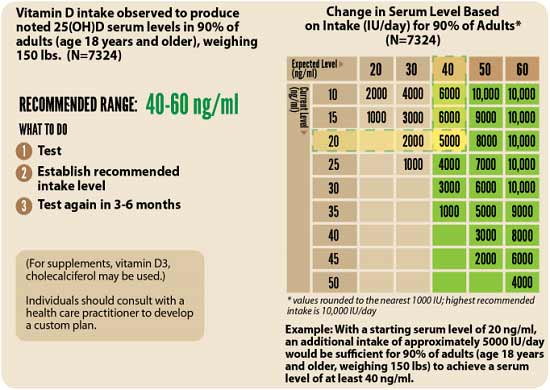
Factors that can influence your vitamin D absorption include your magnesium32 and vitamin K233 intake. Magnesium is required for the conversion of vitamin D into its active form.34,35,36,37 If your magnesium level is insufficient, the vitamin D you ingest orally may simply get stored in its inactive form.38,39
Research by GrassrootsHealth40 shows you need 146% more vitamin D to achieve a blood level of 40 ng/ml (100 nmol/L) if you do not take supplemental magnesium, compared to taking your vitamin D with at least 400 mg of magnesium per day.
Your best bet is to take your vitamin D with both magnesium and K2. According to GrassrootsHealth,41 “combined intake of both supplemental magnesium and vitamin K2 has a greater effect on vitamin D levels than either individually,” and “those taking both supplemental magnesium and vitamin K2 have a higher vitamin D level for any given vitamin D intake amount than those taking either supplemental magnesium or vitamin K2 or neither.”
Data42 from nearly 3,000 individuals revealed 244% more oral vitamin D was required to get 50% of the population to achieve a vitamin D level of 40 ng/ml (100 nmol/L) if they weren’t concurrently also taking magnesium and vitamin K2.
3. Retest in three to six months — Remeasure your vitamin D level in three to six months, to evaluate how your sun exposure and/or supplement dose is working for you.
4. Take activated vitamin D (calcitriol) if your level is low and you come down with an acute infection like COVID. The dose is 0.5 mcg on day one and then 0.25 mcg daily for seven days.

from Articles https://ift.tt/3IIEgDs
via IFTTT
Vitamin D Deficiency Increases Spread of Disease
Being aware of your vitamin D levels and increasing your levels if you’re deficient are two of the simplest steps you can take to stay well. This includes helping to protect against infectious diseases like COVID-19, as a wealth of data show that vitamin D levels are strongly correlated with the severity of SARS-CoV-2 infection.1
In the video above, John Campbell, a retired nurse and teacher based in England, details the findings of yet another study showing that people with higher levels of vitamin D are less likely to die from COVID-19 — and suggesting that, theoretically, “a mortality rate close to zero” could be achieved if your vitamin D level reaches 50 ng/mL.2
This information has been largely ignored by major media, unfortunately, as it has the potential to save lives. The good news is that even if the press continue to ignore it, you can easily heed the advice given in a Nature study, and raise your vitamin D levels to the most protective range.3 This study advised above 50 ng/mL, while aiming for a level between 60 and 80 ng/mL may help prevent a wide range of diseases, including cancer.
Vitamin D Deficiency a Key Factor Behind Severe COVID-19
The study authors believe that low vitamin D levels are not a “side effect” of COVID-19 but rather are a predictor of infection. As vitamin D plays a role in immune function, the epidemic of vitamin D deficiency is increasing the spread of many “diseases of civilization,” such as heart disease,4 along with reducing protection against infections:5
“One strong pillar in the protection against any type of virus infection is the strength of our immune system. Unfortunately, thus far, this unquestioned basic principle of nature has been more or less neglected by the responsible authorities.
It is well known that our modern lifestyle is far from optimal with respect to nutrition, physical fitness, and recreation. In particular, many people are not spending enough time outside in the sun, even in summer.
The consequence is widespread vitamin D deficiency, which limits the performance of their immune systems, resulting in the increased spread of some preventable diseases of civilization, reduced protection against infections, and reduced effectiveness of vaccination.”
Deficiency of vitamin D3 is also “one of the main reasons for severe courses of SARS-CoV-2 infections,” they explained, pointing out that fatality rates tend to be elevated in populations with very low vitamin D3 levels, including elderly people, black people and people with comorbidities.6
In the early 20th century, it was discovered that a vitamin D level of 20 ng/mL was enough to stop osteomalacia, or rickets, and this level is still used today as a marker of “sufficient” vitamin D levels. However, it’s far too low for optimal health and disease prevention beyond rickets.
It’s now known that vitamin D is necessary not only for healthy bones but for health throughout the body. As a powerful epigenetic regulator, vitamin D influences that activity of more than 2,500 genes, and vitamin D receptors are present all over the body, including in the intestine, pancreas, prostate and immune system cells.7 Vitamin D plays a role in numerous diseases, including:8
- Cancer
- Diabetes
- Acute respiratory tract infections
- Chronic inflammatory diseases
- Autoimmune diseases such as multiple sclerosis
Vitamin D Regulates Your Immune Response
Vitamin D receptors are present in nearly all cells of the human immune system, including monocytes/macrophages, T cells, B cells, natural killer cells and dendritic cells. Vitamin D has multiple actions on the immune system, including enhancing the production of antimicrobial peptides by immune cells, reducing damaging pro-inflammatory cytokines and promoting the expression of anti-inflammatory cytokines.9
Cytokines are a group of proteins that your body uses to control inflammation. If you have an infection, your body will release cytokines to help combat inflammation, but sometimes it releases more than it should. If the cytokine release spirals out of control, the resulting “cytokine storm” becomes dangerous and is closely tied to sepsis, which may be an important contributor to the death of COVID-19 patients.10
Many COVID-19 therapeutics are focused on viral elimination instead of modulating the hyper-inflammation often seen in the disease. In fact, uncontrolled immune response has been suggested as a factor in disease severity, making immunomodulation “an attractive potential treatment strategy.”11
Vitamin D is highly relevant here, as it helps to regulate both your innate and adaptive immune systems. However, in order to gain this invaluable benefit, your levels need to be higher than what is officially recommended:12
“Receptor binding engages the formation of the ‘vitamin D3 response element’ (VDRE), regulating a large number of target genes involved in the immune response. As a consequence of this knowledge, the scientific community now agrees that calcitriol is much more than a vitamin but rather a highly effective hormone with the same level of importance to human metabolism as other steroid hormones.
The blood level ensuring the reliable effectiveness of vitamin D3 with respect to all its important functions came under discussion again, and it turned out that 40–60 ng/mL is preferable, which is considerably above the level required to prevent rickets.”
Vitamin D Is Protective Against ARDS
Acute respiratory distress syndrome (ARDS) is a lung condition that’s common in severe COVID-19 cases, which causes low blood oxygen and fluid buildup in the lungs. Along with cytokine release syndrome, ARDS is one of the deadliest complications of COVID-19, and vitamin D inhibits the metabolic pathways that may cause ARDS. According to the Nutrients study:13
“Angiotensin-converting enzyme 2 (ACE2), a part of the renin-angiotensin system (RAS), serves as the major entry point for SARS-CoV-2 into cells. When SARS-CoV-2 is attached to ACE2 its expression is reduced, thus causing lung injury and pneumonia.
Vitamin D3 is a negative RAS modulator by inhibition of renin expression and stimulation of ACE2 expression. It therefore has a protective role against ARDS caused by SARS-CoV-2. Sufficient vitamin D3 levels prevent the development of ARDS by reducing the levels of angiotensin II and increasing the level of angiotensin-(1,7).”
In a previous review,14 researchers also explained that vitamin D has favorable effects during both the early viraemic phase of COVID-19 as well as the later hyperinflammatory phase,15 including ARDS. “Based on many preclinical studies and observational data in humans, ARDS may be aggravated by vitamin D deficiency and tapered down by activation of the vitamin D receptor,”16 they said. “Based on a pilot study, oral calcifediol may be the most promising approach.”
Even regular “booster” doses of vitamin D, regardless of baseline vitamin D levels, appear to be effective in reducing the risk of mortality in people admitted to the hospital with COVID-19, particularly for the elderly.17,18 Further, vitamin D influences several additional functions that also support a robust immune response:19
- Decreases the production of Th1 cells, suppressing the progression of inflammation by reducing inflammatory cytokines produced
- Reduces the severity of the cytokine storm by promoting the differentiation of regulatory T cells
- Induces the production of antimicrobial peptide cathelicidin (LL-37), which fights respiratory viruses by disrupting viral envelopes and altering viability of host target cells
- Reduces abnormal coagulation that often occurs in critically ill COVID-19 patients
COVID-19 Mortality Drops With Higher Vitamin D Levels
The featured study involved a meta-analysis of two data sets. One used long-term average vitamin D3 levels for 19 countries, while the other used data from 1,601 hospitalized COVID-19 patients. The hospital data included 784 patients who had their vitamin D levels measured within 24 hours of admission and 817 patients with previously known vitamin D levels.
A strong correlation was found between SARS-CoV-2 death rate and vitamin D level, such that mortality decreased significantly once vitamin D levels reached 30 ng/mL.20 Further, they noted, “our analysis shows that the correlation for the combined datasets intersects the axis at approximately 50 ng/mL, which suggests that this vitamin D3 blood level may prevent any excess mortality.”21
Given their findings, the authors recommend “routine strengthening of the immune system of the whole population by vitamin D3 supplementation to consistently guarantee blood levels above 50 ng/mL (125 nmol/L).”22 Researchers in Indonesia, who looked at data from 780 COVID-19 patients, also found those with a vitamin D level between 21 ng/mL (52.5 nmol/L) and 29 ng/mL (72.5 nmol/L) had a 12.55 times higher risk of death than those with a level above 30 ng/mL.23
Having a level below 20 ng/mL was associated with a 19.12 times higher risk of death. A “majority of the COVID-19 cases with insufficient and deficient Vitamin D status died,” they added.24
How Much Vitamin D Do You Need?
The best way to know how much vitamin D you need is to have your levels tested. It’s possible to optimize your vitamin D levels via sensible sun exposure, but if this isn’t an option for you then daily vitamin D3 supplementation of up to 10,000 units may be needed to reach a vitamin D level of 40 to 60 ng/mL.
However, if you have COVID, and you haven't been tested, it is best to take the prescription form of vitamin D called calcitriol, which is the activated form of vitamin D, as it works immediately. The dose is 0.5 mcg the first day and then 0.25 mcg for one week. This is a prescription drug. You should also take 10,000 units of regular vitamin D which will start to kick in once you are off the calcitriol.
It’s also important to note that vitamin D supplementation must be balanced with other nutrients, namely vitamin K2 (to avoid complications associated with excessive calcification in your arteries), calcium and magnesium. For another perspective, data from GrassrootsHealth's D*Action studies suggest the optimal level for health and disease prevention is between 60 ng/mL and 80 ng/mL, while the cutoff for sufficiency appears to be around 40 ng/mL. In Europe, the measurements you're looking for are 150 to 200 nmol/L and 100 nmol/L respectively.
Given the impressive findings from the featured study and others, it’s mind-boggling why large-scale studies aren’t being immediately implemented to determine best dosages of vitamin D to protect against COVID-19. As Campbell said, “The fact that medical authorities are not doing this, because it’s such a simple observational study, really is getting into the bounds of negligence.”25

from Articles https://ift.tt/3ykJwrX
via IFTTT
MKRdezign
Powered by Blogger.