Health, Fitness,Dite plan, health tips,athletic club,crunch fitness,fitness studio,lose weight,fitness world,mens health,aerobic,personal trainer,lifetime fitness,nutrition,workout,fitness first,weight loss,how to lose weight,exercise,24 hour fitness,
Labels
Technology
New Post
[recent][newsticker]
Latest Post
Top Health News -- ScienceDaily
Aging
Alzheimer's
Articles
Articles : Asthma
Articles : CAFO
Articles : Children's Health
Articles : Cholesterol
Articles : Emotional Health
Articles : Fibromyalgia
Articles : GMO
Articles : Heart Health
Articles : Hormones
Articles : Internal Videos
Articles : Interviews
Articles : Men's Health
Articles : Politics
Articles : Thyroid Disease
Articles : Vaccines
Autism
best natural health source
Children's Health
Detoxification
Diabetes
Diet | body+soul
Diet and Weight Loss News -- ScienceDaily
Digestive Diseases
Dite
Dite & weight loss
Drug Industry
Drugs
EFT
EMF
Emotional Health
Finances
fitness
Fitness | body+soul
Fitness/Exercise
Fluoride
Food
Fructose/Sugar
Gardening
Harvard Health Blog
Health
Health | body+soul
Health and Wellness
health news
health tips
Heart Health
information
Joint Support
Juicing
Men's Health
news
Nutrition
Nutrition | body+soul
Pollution
Raw Milk
Soy
Supplements
Swine Flu
Technology
Thyroid Disease
Top Health
Top Health News -- ScienceDaily
Under Armour
Vaccines
Weight Management
women's health
Women's Health News -- ScienceDaily
work place health
Workplace Health News -- ScienceDaily
Why the fight for gender equality can be won on the footy field
Indigenous activist and sports podcaster Marlee Silva investigates.
from Health | body+soul https://ift.tt/3Fib6JM
from Health | body+soul https://ift.tt/3Fib6JM
The Secret to Raising Smart Kids
More than three decades of scientific research suggests that repeatedly telling children that they are especially smart or talented leaves them vulnerable to failure, and fearful of challenges.
Children raised this way develop an implicit belief that intelligence is innate and fixed, making striving to learn seem less important than seeming smart; challenges, mistakes, and effort become threats to their ego rather than opportunities to improve.
However, teaching children to have a “growth mind-set,” which encourages effort rather than on intelligence or talent, helps make them into high achievers in school and in life. This results in “mastery-oriented” children who tend to think that intelligence is malleable and can be developed through education and hard work.
This can be done by telling stories about achievements that result from hard work. Talking about math geniuses who were born that way puts students in a fixed mind-set, but descriptions of great mathematicians who developed amazing skills over time creates a growth mind-set.

from Articles : Hormones, Supplements https://ift.tt/3swcpxQ
via IFTTT
Study Found Toxin from GM Crops is Showing up in Human Blood
 A new study is causing fresh doubts about the safety of genetically modified crops. The research found Bt toxin, which is present in many GM crops, in human blood.
Bt toxin makes crops toxic to pests, but it has been claimed that the toxin poses no danger to the environment and human health; the argument was that the protein breaks down in the human gut. But the presence of the toxin in human blood shows that this does not happen.
India Today reports:
“Scientists ... have detected the insecticidal protein ... circulating in the blood of pregnant as well as non-pregnant women. They have also detected the toxin in fetal blood, implying it could pass on to the next generation.”

from Articles : GMO, Detoxification https://ift.tt/1h9xRQo
via IFTTT
The Role of Magnesium for Cognitive Function in Older Adults
Health & Fitness
22:20
Aging
,
Articles : Cholesterol
,
best natural health source
,
health news
,
Juicing
I've previously discussed the synergy between magnesium and vitamin D, and the importance of vitamin D for optimal immune function and overall health — especially as it pertains to lowering your risk of COVID-19. Previous studies have also highlighted the role this duo plays in cognitive function among older adults, as well as overall mortality.
Vitamin D and Magnesium Protect Cognitive Health
One such study,1 "Association of Vitamin D and Magnesium Status with Cognitive Function in Older Adults: Results from the National Health and Nutrition Examination Survey (NHANES) 2011 to 2014," points out that vitamin D not only protects neuronal structures and plays a role in neuronal calcium regulation, but also appears to impact your risk for neurodegeneration as you grow older.
Magnesium, meanwhile, aside from being required for converting vitamin D to its active form,2,3,4 also plays a role in cognitive health, and magnesium deficiency has been implicated in several neurological disorders.
Using NHANES data from 2,984 participants over the age of 60, the researchers compared serum vitamin D status and dietary magnesium intake against cognitive function scores.
After adjusting for confounding factors, including total calorie consumption and magnesium intake, higher blood levels of vitamin D positively correlated with decreased odds of having a low cognitive function score on the Digit Symbol Substitution Test.
The same trend was found when they looked at vitamin D intake, rather than blood level. The correlation of higher vitamin D levels and better cognitive function was particularly strong among those whose magnesium intake was equal to or greater than 375 mg per day. According to the authors:5
"We found that higher serum 25(OH)D levels were associated with reduced risk of low cognitive function in older adults, and this association appeared to be modified by the intake level of magnesium."
Magnesium Improves Brain Plasticity
While magnesium intake by itself did not appear to have an impact on cognitive function in the study above, other research has highlighted its role in healthy cognition.
Memory impairment occurs when the connections (synapses) between brain cells diminish. While many factors can come into play, magnesium is an important one. As noted by Dr. David Perlmutter, a neurologist and fellow of the American College of Nutrition:6
"It has now been discovered that magnesium is a critical player in the activation of nerve channels that are involved in synaptic plasticity. That means that magnesium is critical for the physiological events that are fundamental to the processes of learning and memory."
A specific form of magnesium called magnesium threonate was in 2010 found to enhance "learning abilities, working memory, and short- and long-term memory in rats."7 According to the authors, "Our findings suggest that an increase in brain magnesium enhances both short-term synaptic facilitation and long-term potentiation and improves learning and memory functions."
COVID-19 Can Deprive Brain of Oxygen
While we're on the topic of the brain, a July 1, 2020, article8 in The Washington Post reviewed findings from autopsies of COVID-19 patients. Surprisingly, Chinese researchers have reported9 that COVID-19 patients can exhibit a range of neurological manifestations.
A June 12, 2020, letter to the editor10 published in The New England Journal of Medicine also discusses the neuropathological features of COVID-19. As reported by The Washington Post:11
"Patients have reported a host of neurological impairments, including reduced ability to smell or taste, altered mental status, stroke, seizures — even delirium … In June, researchers in France reported that 84% of patients in intensive care had neurological problems, and a third were confused or disoriented at discharge.
… Also this month, those in the United Kingdom found that 57 of 125 coronavirus patients with a new neurological or psychiatric diagnosis had experienced a stroke due to a blood clot in the brain, and 39 had an altered mental state.
Based on such data and anecdotal reports, Isaac Solomon, a neuropathologist at Brigham and Women's Hospital in Boston, set out to systematically investigate where the virus might be embedding itself in the brain.
He conducted autopsies of 18 consecutive deaths, taking slices of key areas: the cerebral cortex (the gray matter responsible for information processing), thalamus (modulates sensory inputs), basal ganglia (responsible for motor control) and others …"
Interestingly, while doctors and researchers initially suspected that brain inflammation was causing the neurological problems seen in some patients, Solomon's autopsies found very little inflammation. Instead, these neurological manifestations appear to be the result of brain damage caused by oxygen deprivation.
Signs of oxygen deprivation were present both in patients who had spent a significant amount of time in intensive care, and those who died suddenly after a short but severe bout of illness. I believe this is likely due to increases in clotting in the brain microvasculature.
Solomon told The Washington Post he was "very surprised," by the finding. It makes sense, though, considering COVID-19 patients have been found to be starved for oxygen. As reported by The Washington Post:12
"When the brain does not get enough oxygen, individual neurons die … To a certain extent, people's brains can compensate, but at some point, the damage is so extensive that different functions start to degrade … The findings underscore the importance of getting people on supplementary oxygen quickly to prevent irreversible damage."
Magnesium and Vitamin D Impact Mortality
Getting back to magnesium and vitamin D, previous research13 using NHANES data from 2001 through 2006 found the duo has a positive impact on overall mortality rates. This study also pointed out that magnesium "substantially reversed the resistance to vitamin D treatment in patients with magnesium-dependent vitamin-D-resistant rickets."
The researchers hypothesized that magnesium supplementation increases your vitamin D level by activating more of it, and that your mortality risk might therefore be lowered by increasing magnesium intake. That is indeed what they found. According to the authors:
"High intake of total, dietary or supplemental magnesium was independently associated with significantly reduced risks of vitamin D deficiency and insufficiency respectively. Intake of magnesium significantly interacted with intake of vitamin D in relation to risk of both vitamin D deficiency and insufficiency.
Additionally, the inverse association between total magnesium intake and vitamin D insufficiency primarily appeared among populations at high risk of vitamin insufficiency.
Furthermore, the associations of serum 25(OH)D with mortality, particularly due to cardiovascular disease (CVD) and colorectal cancer, were modified by magnesium intake, and the inverse associations were primarily present among those with magnesium intake above the median.
Our preliminary findings indicate it is possible that magnesium intake alone or its interaction with vitamin D intake may contribute to vitamin D status. The associations between serum 25(OH)D and risk of mortality may be modified by the intake level of magnesium."
Magnesium Lowers Vitamin D Requirement by 146%
According to a scientific review14,15 published in 2018, as many as 50% of Americans taking vitamin D supplements may not get significant benefit as the vitamin D simply gets stored in its inactive form, and the reason for this is because they have insufficient magnesium levels.
Research published in 2013 also highlighted this issue, concluding that higher magnesium intake helps reduce your risk of vitamin D deficiency by activating more of it. As noted by the authors:16
"High intake of total, dietary or supplemental magnesium was independently associated with significantly reduced risks of vitamin D deficiency and insufficiency respectively.
Intake of magnesium significantly interacted with intake of vitamin D in relation to risk of both vitamin D deficiency and insufficiency … Our preliminary findings indicate it is possible that magnesium intake alone or its interaction with vitamin D intake may contribute to vitamin D status."
More recently, GrassrootsHealth concluded17 you need 146% more vitamin D to achieve a blood level of 40 ng/ml (100 nmol/L) if you do not take supplemental magnesium, compared to taking your vitamin D with at least 400 mg of magnesium per day.
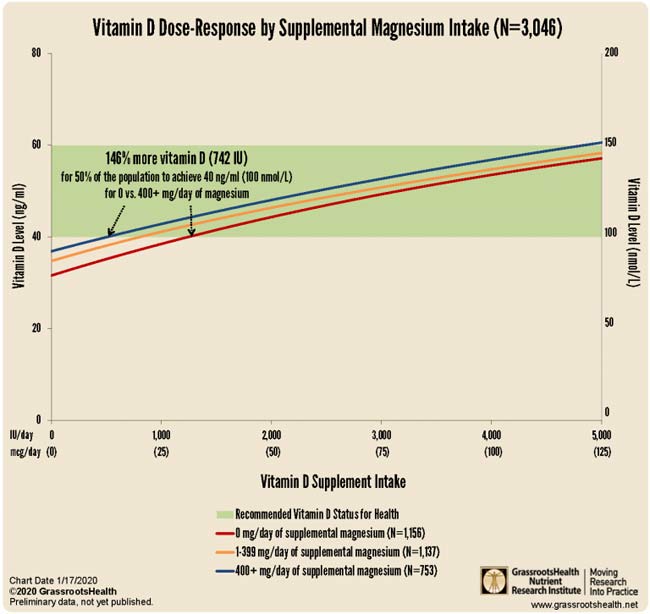
The interplay between magnesium and vitamin D isn't a one-way street, though. It goes both ways. Interestingly, while vitamin D improves magnesium absorption,18 taking large doses of vitamin D can also deplete magnesium.19 Again, the reason for that is because magnesium is required in the conversion of vitamin D into its active form.
Magnesium + Vitamin K Lowers Vitamin D Requirement Even More
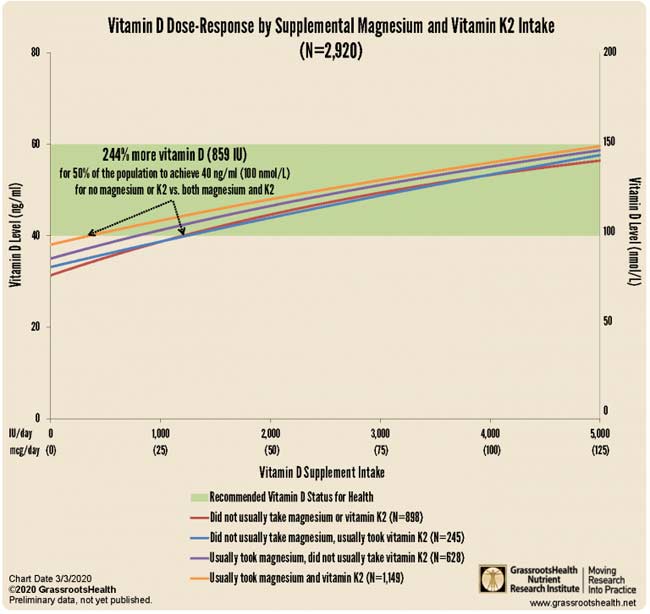
Magnesium isn't the only nutrient that can have a significant impact on your vitamin D status. GrassrootsHealth data further reveal you can lower your oral vitamin D requirement by a whopping 244% simply by adding magnesium and vitamin K2. As reported by GrassrootsHealth:20
"… 244% more supplemental vitamin D was needed for 50% of the population to achieve 40 ng/ml (100 nmol/L) for those not taking supplemental magnesium or vitamin K2 compared to those who usually took both supplemental magnesium and vitamin K2."
How to Boost Your Magnesium Level
The recommended daily allowance for magnesium is around 310 mg to 420 mg per day depending on your age and sex,21 but many experts believe you may need anywhere from 600 mg to 900 mg per day.22
Personally, I believe many may benefit from amounts as high as 1 to 2 grams (1,000 to 2,000 mg) of elemental magnesium per day, as most of us have EMF exposures that simply cannot be mitigated, and the extra magnesium may help lower the damage from that exposure.
My personal recommendation is that unless you have kidney disease and are on dialysis, continually increase your magnesium dose until you have loose stools and then cut it back. You want the highest dose you can tolerate and still have normal bowel movements.
When it comes to oral supplementation, my personal preference is magnesium threonate, as it appears to be the most efficient at penetrating cell membranes, including your mitochondria and blood-brain barrier. But I am also fond of magnesium malate, magnesium citrate, and ionic magnesium from molecular hydrogen as each tablet has 80 mg of elemental magnesium.
Eat More Magnesium-Rich Foods
Last but not least, while you may still need magnesium supplementation (due to denatured soils), it would certainly be wise to try to get as much magnesium from your diet as possible. Dark-green leafy vegetables lead the pack when it comes to magnesium content, and juicing your greens is an excellent way to boost your intake. Foods with high magnesium levels include:23
|
Avocados |
Swiss chard |
|
Turnip greens |
Beet greens |
|
Herbs and spices such as coriander, chives, cumin seed, parsley, mustard seeds, fennel, basil and cloves |
|
|
Brussel sprouts |
Organic, raw grass fed yogurt and natto |
|
Romaine lettuce |

from Articles : Cholesterol, Aging, Juicing https://ift.tt/3j7gu77
via IFTTT
The Importance of Muscle in Healthy Aging
Health & Fitness
22:20
Aging
,
Articles : Cholesterol
,
best natural health source
,
health news
,
Juicing
The older you get, the more important your muscle mass becomes. Not only are strong muscles a requirement for mobility, balance and the ability to live independently, but having reserve muscle mass will also increase your chances of survival1 when sick or hospitalized.
Muscle is lost far more easily and quicker than it’s built, so finding ways to continuously promote and maintain your muscle mass is really crucial, especially as you get older.
Age-related loss of muscle mass is known as sarcopenia, and if you don’t do anything to stop it you can expect to lose about 15% of your muscle mass between your 30s and your 80s.2 An estimated 10% to 25% of seniors under the age of 70 have sarcopenia and as many as half those over the age of 80 are impaired with it.3
In the lecture above, Brendan Egan, Ph.D., associate professor of sport and exercise physiology at the School of Health and Human Performance and the National Institute for Cellular Biotechnology at Dublin City University in Ireland, reviews the latest research on exercise training for aging adults, which places a significant focus on building and maintaining muscle, and the nutritional components that can help optimize training results.
Muscle Strength and Function in Relation to Muscle Size
While it’s true that larger muscle is indicative of stronger, more functional muscle, it’s not a true 1-to-1 relationship. As noted by Egan, “you can have situations where you can gain back function without necessarily gaining muscle size.” To illustrate this point, Egan presents data from the Baltimore Longitudinal Study of Aging, which looked at leg strength and lean muscle mass.
While declines in muscle mass and strength are relatively well-synchronized in the 35- to 40-year-old group, strength dramatically drops off as you get into the 75-year-old and over groups, with 85-year-olds seeing dramatic declines in strength and function relative to the decline in muscles size.
Speed as a Measure of Functional Muscle Capacity
One way to measure functional capacity in older adults is gait (walking) speed, which is a strong predictor of life expectancy. Data suggest that if you have a walking speed of 1.6 meters (about 5.2 feet) per second (approximately 3.5 mph) at the age of 65, your life expectancy is another 32 years, meaning you may live into your late 90s.
Having a walking speed at or below the cutoff for sarcopenia, which is 0.8 meters (about 2.6 feet) per second, your life expectancy would be another 15 years, which means you’d be predicted to live to 80. At this speed, you would not be able to make it safely across a typical pedestrian crossing before the light changes to red.
Strength as a Predictor of Survival
Strength can also tell us a lot about an individual’s chances of survival. Egan presents data from a study in which people’s chest and leg press strength were measured to arrive at a composite score of whole body strength. The pattern is quite revealing, showing the strongest one-third of the population over 60 had a 50% lower death rate than the weakest.
Exercise guidelines recommend getting 150 minutes of aerobics exercise and two strength training sessions per week. As noted by Egan, you need both. It’s not just one or the other.
Research shows aerobic exercise in isolation reduces your all-cause mortality by 16% and strength training-only reduces it by 21%, whereas if you do both, you reduce your all-cause mortality by 29%.4 Disturbingly, U.K. data suggest only 36.2% of adults over the age of 30 meet aerobic guidelines, and a minuscule 3.4% meet strength training guidelines.
Part of the problem may be that many don’t want to go to the gym. But there’s little difference between doing gym-based strength training and doing bodyweight resistance training at home.
The Danger of Bedrest and Disuse Atrophy
As noted by Egan, enforced bedrest, such as acute hospitalization, can have a dramatic impact on your muscle mass. For example, a 2015 review5 in Extreme Physiology & Medicine notes you can lose 2.5% of your muscle mass in the first two weeks of bedrest. By Day 23, you can have lost up to 10% of your quadriceps muscle mass. As explained in this review:6
“Skeletal muscle mass is regulated by a balance between MPS [muscle protein synthesis] and MPB [muscle protein breakdown]. In a 70-kg human, approximately 280 g of protein is synthesized and degraded each day.
The two processes are linked … as facilitative or adaptive processes, whereby MPS facilitates (allows modulation of muscle mass) and MPB adapts (limiting said modulation).
When exposed to an anabolic stimulus, MPS rises. MPB rises too, but to a lesser amount, resulting in a net synthetic balance. In response to an anti-anabolic stimulus, MPS decreases and MPB decreases to a lesser degree, resulting in a net breakdown.
The interaction between critical illness and bed rest may result in greater muscle loss compared to bed rest alone. The musculoskeletal system is a highly plastic and adaptive system, responding quickly to changing demands. Relatively short periods of immobilization decrease MPS, with no effect on MPB.
Furthermore, this altered balance is relatively resistant to high dose amino acid delivery … Immobilization has significant effects on peripheral muscle aerobic capacity, contractility, insulin resistance and architecture.
Microvascular dysfunction occurring in severe sepsis is associated with immobilization and may have an additive effect on reducing MPS. In critically ill patients, MPS is reduced even with nutritional delivery, with increased MPB seen, leading to a net catabolic state and thus muscle wasting.”
Research7 has shown even healthy young subjects in their 20s can lose 3.1 pounds of muscle mass in a single week of bedrest. This is why it is so important to have a reserve in case you wind up in the hospital and lose this much muscle mass. It may take you the better part of a year to regain that muscle, as gaining muscle mass is hard work and many elderly fail to do so.
The loss of muscle mass also significantly decreases your insulin sensitivity. One of the reasons for this has to do with the fact that muscle tissue is a significant reservoir for the disposal of glucose. Your muscle tissue also produces cytokines and anti-inflammatory myokines that play an important role in health.
Concurrent Exercise Training
While three to five sessions of aerobic exercise and two or more strength sessions per week may sound like a lot, for many, the lack of time is a restricting factor. However, some of these sessions can be done together. “That’s called concurrent exercise training,” Egan says.
He goes on to cite research looking at time matched concurrent exercise in the elderly, 65 and older, where an aerobic training group and a strength training group were compared to a group that spent half of their session doing aerobic exercise and the other half doing resistance training. All groups spent the same overall time exercising (30 minutes, three times a week for 12 weeks).
In terms of leg strength, the concurrent training group had better responses to training than aerobic or strength training alone. There was little difference in lean body mass, meaning they didn’t necessarily bulk up, but they had a 50% increase in strength nonetheless. They also lost more body fat around the trunk area. In short, concurrent training appears to give you more bang for your buck.
Blood Flow Restriction Training
One of the reasons I’m so passionate about blood flow restriction (BFR) training is because it has the ability to prevent and widely treat sarcopenia like no other type of training.
There are several reasons why BFR is far superior to conventional types of resistance training in the elderly. Importantly, it allows you to use very light weights, which makes it suitable for the elderly and those who are already frail or recovering from an injury. And, since you’re using very light weights, you don’t damage the muscle and therefore don’t need to recover as long.
While most elderly cannot engage in high-intensity exercise or heavy weightlifting, even extraordinarily fit individuals in their 60s, 70s and 80s who can do conventional training will be limited in terms of the benefits they can achieve, thanks to decreased microcirculation. This is because your microcirculation tends to decrease with age.
With age, your capillary growth diminishes, and capillary blood flow is essential to supply blood to your muscle stem cells, specifically the fast twitch Type II muscle fiber stem cells. If they don’t have enough blood flow — even though they’re getting the signal from the conventional strength training — they’re not going to grow and you’re not going to get muscle hypertrophy and strength.
BFR, because of the local hypoxia that is created, stimulates hypoxia-inducible factor-1 alpha (HIF1a) and, secondarily, vascular endothelial growth factor (VEGF), which acts as “fertilizer” for your blood vessels. VEGF allows your stem cells to function the way they were designed to when they were younger.
What’s more, the hypoxia also triggers vascular endothelial growth factor, which enhances the capillarization of the muscle and likely the veins in the arteries as well. Building muscle and improving blood vessel function are related, which is why BFR offers such powerful stimulus for reversing sarcopenia.
In short, BFR has a systemic or crossover training effect. While you’re only restricting blood flow to your extremities, once you release the bands, the metabolic variables created by the hypoxia flow into your blood — lactate and VEGF being two of them — thereby spreading this “metabolic magic” throughout your entire system. To learn more, please see my special report, “What You Need to Know About BFR,” and “BFR Training for Muscle Mass Maintenance.”
Nutrition for Muscle Maintenance
It should come as no surprise that there is an important synergy between nutrition and exercise. When it comes to muscle building and maintenance, amino acids, the building blocks of protein, are of particular importance.
In the podcast above, Megan Hall, scientific director at Nourish Balance Thrive delves into this topic at greater depth and reviews the current recommended daily allowances of protein compared to the optimal levels needed to support muscle mass and strength in at various life stages.8
Research9 looking at post-prandial protein handling and amino acid absorption shows 55.3% of the dietary protein of a given meal is in circulation within five hours after eating, which significantly increases muscle protein synthesis.
Research10 suggests healthy young adult men “max out the protein synthesis signal from a given meal” at a dose of 0.24 grams of protein per kilogram of total bodyweight, or 0.25 grams of protein per kilogram of lean body mass.
The current U.S.-Canadian recommended dietary protein allowance is 0.8 g/kg/d (0,36/grams/pound/day), but healthy older adults may actually require about 1.20 g/kg/d or .55 grams/pound/day. According to this study:11
“Our data suggest that healthy older men are less sensitive to low protein intakes and require a greater relative protein intake, in a single meal, than young men to maximally stimulate postprandial rates of MPS [myofibrillar protein synthesis].
These results should be considered when developing nutritional solutions to maximize MPS for the maintenance or enhancement of muscle mass with advancing age.”
Amino acids also act as signaling molecules that trigger muscle growth. Leucine is a particularly potent signaling agent, although all of the amino acids are required to actually build the muscle. The richest source of leucine (which helps regulate the turnover of protein in your muscle), by far, is whey protein. In fact, it can be difficult to obtain sufficient amounts of leucine from other sources.
The typical requirement for leucine to maintain body protein is 1 to 3 grams daily. However, to optimize its anabolic pathway, research shows12 you need somewhere between 8 and 16 grams of leucine per day, in divided doses.13,14
To reach the 8-gram minimum, you’d have to eat nearly 15 eggs.15 Whey, on the other hand, contains about 10% leucine (10 grams of leucine per 100 grams of protein).16 So, 80 grams of whey protein will give you 8 grams of leucine.
Time-Restricted Eating Adds Benefits
One of the problems with Egan is that he’s not very literate on time-restricted eating. During the question and answer portion, an audience member asks him about it and he admits he hasn’t studied it.
This is important because restricting your eating window to six to eight hours, which means you’re fasting 14 to 18 hours each day, would make it far easier for each of the meals to be over the leucine threshold. It will also activate autophagy, which is another factor essential for optimal muscle growth.
Autophagy is a self-cleaning process in which your body digests damaged cells, which in turn encourages the proliferation of new, healthy cells. The harder your workout, the more autophagy you will activate.
So, I recommend fasting for as long as you can before your morning workout, and then, shortly thereafter, have your largest meal of the day with plenty of high-quality protein, making sure you get several grams of leucine and arginine, both of which are potent mTOR stimulators.
The mTOR pathway is an important key for protein synthesis and muscle building. As explained in David Sabatini’s excellent review paper “mTOR at the Nexus of Nutrition, Growth, Ageing and Disease,” published in Nature Reviews Molecular Cell Biology:17
“Over the past two and a half decades, mapping of the mTOR signaling landscape has revealed that mTOR controls biomass accumulation and metabolism by modulating key cellular processes, including protein synthesis and autophagy.
Given the pathway’s central role in maintaining cellular and physiological homeostasis, dysregulation of mTOR signaling has been implicated in metabolic disorders, neurodegeneration, cancer and ageing.”
In summary, fasting activates autophagy, allowing your body to clean out damaged subcellular parts. Exercising while fasted maximizes autophagy even further. In fact, exercising while you are fasting for more than 14 to 18 hours likely activates as much autophagy as if you were fasting for two to three days. It does this by increasing AMPK, increasing NAD+ and inhibiting mTOR.
Refeeding with protein after your fasted workout then activates mTOR, thus shutting down autophagy and starting the rebuilding process. These two processes need to be cyclically activated to optimize your health and avoid problems.
Muscle Health Is Central to an Active Lifestyle
As noted by Egan, “Hopefully I've convinced you that muscle health is central to active lifestyles. There's been this increased awareness of muscle size, but I think we need to emphasize the idea about strength and function. These are the things that are easiest to change with the right type of training.”
In short, if you want to increase muscle size and strength, then there’s no getting around resistance training. It simply must be part of your exercise prescription, and concurrent training, where you’re combining aerobic and strength training in a given session is a time-efficient model.
BFR is also a particularly excellent way to ensure you’re getting effective strength training without the risks of conventional strength training using heavy weights, and is easy to combine with exercises such as walking and swimming. You simply wear the BFR bands while walking or exercising as normal.
Defy Aging by Improving Your Muscle Mass
In my February 2020 interview with Ben Greenfield, author of “Boundless: Upgrade Your Brain, Optimize Your Body & Defy Aging,” we discuss the importance of strength training and getting the appropriate amount of protein to build and maintain your muscle mass and optimize mitochondrial density and biogenesis.
In summary, Greenfield recommends a fitness program that includes the following types of exercise in order to target the main pathways involved in health and aging:
• High-intensity interval training once a week to boost mitochondrial density and biogenesis — Brief spurts of exercise followed by longer rest periods. Greenfield recommends a 3-to-1 or 4-to-1 rest-to-work ratio.
• Muscle endurance training two to three times a week to improve lactic acid tolerance — An example is the classic Tabata set, which has a 2-to-1 work-to-rest ratio.
• Longer training sessions twice a week to improve your VO2 max — To target and improve your VO2 max, you’ll want your training sessions to be longer, about four to six minutes in duration with four to six minutes of recovery in between, for a 1-to-1 work-to-rest ratio.
Examples include The New York Times' seven-minute workout18 and bodyweight training done in a fast explosive manner or with a very light medicine ball, sandbag or kettle bells.
• Long walk once a week to improve your stamina — Greenfield recommends taking a 1.5- to three-hourlong walk, bike ride or paddle session — anything where your body is engaged in chronic repetitive motion for a long period of time — preferably in a fasted state. Alternatively, do 20 to 30 minutes of fasted cardio followed by a cold shower.
• Super-slow weight training once or twice a week to improve muscle strength — Alternatives include elastic band training systems and blood flow restriction (BFR) training. You can also combine BFR with super-slow training.

from Articles : Cholesterol, Aging, Juicing https://ift.tt/3cXtg54
via IFTTT
Omega-3 Index More Predictive Than Cholesterol Levels
Health & Fitness
22:20
Aging
,
Articles : Cholesterol
,
best natural health source
,
health news
,
Juicing
The ketogenic diet is beneficial for many people as it helps with weight control and management and offers protection against a number of health ailments. Approached incorrectly, however, it can actually be harmful.
In this short video Dr. Eric Berg warns, "The last thing you want to do is get the benefits of the ketogenic diet but then have deficiencies of omega-3 fatty acids." If you're following a standard ketogenic nutrition plan I recommend you focus on eating healthy fats and 1 gram of protein for every kilogram of body mass. You should also keep your net carbohydrates to not more than 10% of your daily calories.
However, if you're not getting enough omega-3 fat it can be detrimental to your health. As Berg describes, your body uses fat for many reasons, including the lining and protection of cell membranes, the processing of fat soluble vitamins, the catalyzation of chemical reactions, and the production of hormones and bile. Without enough healthy fat, and the right kinds of fat, you may increase your risk for negative health conditions.
Omega-3 fats are one type of polyunsaturated fats (PUFAs) you must get from your food since your body doesn't make them.1 The second type of PUFAs are omega-6 fats. Your body needs both in a balanced ratio for optimal health.
As the National Institutes of Health describes,2 "The three main omega-3 fatty acids are alpha-linolenic acid (ALA), eicosapentaenoic acid (EPA) and docosahexaenoic acid (DHA). ALA is found mainly in plant oils such as flaxseed, soybean and canola oils. DHA and EPA are found in fish and other seafood."
Omega-3 Fats Are Crucial to Heart Health
EPA, DHA and ALA each have unique functions. DHA is particularly important for your brain,3 as about 90 percent of the fat in your brain is DHA, while EPA appears to be of particular importance for heart health.4 ALA, found in plants, is the "parent fatty acid" and is used as a source of energy.
However, while some may be converted to EPA and DHA in the body, conversion to EPA is restricted and unreliable, and conversion to DHA is severely restricted.5 Making lifestyle changes, such as exercising, stopping smoking and improving your diet, have a significant impact on your heart health.
The authors of one study published in the New England Journal of Medicine6 analyzed the risk of a cardiovascular event while taking icosapent ethyl. The medication is a "highly purified eicosapentaenoic acid ethyl ester" that is "a synthetic derivative of omega-3 fatty acid."7
The data8 were based on information gathered from 8,179 participants who were followed over a period of 4.9 years. The researchers identified end points of the study as death from a cardiac event, or a nonfatal heart attack or stroke.
The participants either had heart disease or risk factors for it and were taking statins. They were given either a placebo or 2 grams of icosapent ethyl twice a day. Those who took the medication had a significantly lower number of ischemic events than those taking the placebo.
Although the drug had previously been approved in 2012 for people with high triglycerides, in December 2019 the FDA approved it for use alongside statins.9 Its mechanism of action has not been completely identified, but the American Heart Association lists the following reasons natural omega-3 may have an impact on lowering the risk of heart disease:10
|
Lowers triglyceride levels and increases HDLs |
Decreases platelet aggregation and prevents blockage of coronary artery |
|
Lowers resting blood pressure |
Increases compliance of arteries |
|
Decreases atherosclerosis |
Reduces inflammatory markers |
|
Decreases risk of abnormal heart rhythms |
As explained in a meta-analysis published in Circulation,11 scientists concluded there was a growing body of evidence that omega-3 fats can prevent sudden cardiac death by "modulating ion channels so as to stabilize the cardiomyocytes electrically."
EPA and DHA Lowers Inflammation, Pain and Depression
EPA and DHA have been shown to improve blood pressure,12 reduce overall inflammation, reduce the effects of rheumatoid arthritis13 and depression14 and help to slow the progression of Alzheimer's disease.15
Other conditions linked to inflammation that are positively affected by omega-3 fatty acids are Hashimoto's disease and inflammatory bowel disease. Nutritionist Steph Lowe spoke with Starts at 60 about omega-3 fats, saying:16
"Fish oil is a natural alternative to non-steroidal anti-inflammatory drugs (NSAID), without the side effects but with the potential to reduce the inflammatory response and thereby reduces joint stiffness and pain."
Your Body Needs Cholesterol for Vital Functions
For decades you've been told that high cholesterol levels will increase your risk for heart disease. In fact, some in the health community continue to stress your level of cholesterol as a biomarker for heart risk, when in fact it's smarter to take a global view of cholesterol — how it affects your body and what you can do to reduce your risk of heart disease beyond the simple narrative which focuses on cholesterol as some kind of culprit.
Cholesterol is vital to your overall health, as it helps with the manufacturing of hormones and vitamin D. About 80% of the cholesterol in your body is made in your liver and intestines, while the rest has to come from your food.17
There are two categories of cholesterol: The first is high density lipoprotein (HDL), which many know as the "good" type that moves cholesterol out of your arteries.18
The second is low-density lipoprotein (LDL) or what many know as the "bad" type that may build up and form plaque in the arteries. The American Heart Association focuses on your total cholesterol number, which they recommend you keep at 150 milligrams per deciliter (mg/dL).19
In the 2015-2020 Dietary Guidelines for Americans, it's noted that the Institute of Medicine recommends20 "… individuals should eat as little dietary cholesterol as possible while consuming a healthy eating pattern." However, in the Scientific Report of the 2015 Dietary Guidelines Advisory Committee, it was acknowledged that "… cholesterol is not considered a nutrient of concern for overconsumption."21
It's troubling to know that the public hears one thing and something completely different is discussed at a medical advisory meeting.
Using cholesterol as a sole marker for the risk of heart disease is inaccurate because, like most things related to your body, its mechanisms are complex and interrelated. Increasing amounts of evidence show that people with higher levels of cholesterol live longer lives.22 As summarized by the authors of one study:
"Overall, an inverse trend is found between all-cause mortality and total (or low density lipoprotein [LDL]) cholesterol levels: mortality is highest in the lowest cholesterol group without exception … elderly people with the highest cholesterol levels have the highest survival rates irrespective of where they live in the world."
While evaluating your heart disease risk, consider your fasting insulin and blood sugar levels, waist circumference and iron levels. I discuss the relationships of these factors to your heart health and the importance of differentiating the types of LDL in "Important Facts About Cholesterol and Heart Disease."
There are a number of ways higher levels of cholesterol may have a protective effect on your health; these are discussed in "Higher Cholesterol is Associated With Longer Life." Instead of looking at simple levels, there are two indicators that are important: your HDL/total cholesterol ratio and your triglyceride/HDL ratio.
Why Testing Your Omega-3 Level Is so Important
An omega-3 deficiency leaves you vulnerable to several chronic diseases and lifelong challenges. Optimizing your levels is truly a foundational strategy to attaining and maintaining good health. The best way to determine if you're eating enough food with omega-3 is to get tested.
In fact, research23 supported by the National Institutes of Health suggests that an omega-3 test is a good predictor of overall health and all-cause mortality.24
Leaders of the study measured the omega-3 index in 2,500 participants; they found that those with the highest omega-3 index had lower risks of heart problems. The omega-3 Index is a measure of the amount of EPA and DHA in the membranes of your red blood cells (RBCs). As Berg mentioned, fat is a component of cell membranes.
Your index is expressed as a percent of your total RBC fatty acids. The omega-3 index has been validated as a stable, long-term marker of your omega-3 status, and it reflects your tissue levels of EPA and DHA. I just had my omega-3 index done last week from GrassrootsHealth and it was 11.1% and my 6:3 ratio was 2.7.
An omega-3 index over 8% is associated with the lowest risk of death from heart disease, while an index below 4% places you at the highest risk of heart disease-related mortality. Given its importance to your health, it is absolutely worth your time to complete the simple blood test required to determine your omega-3 index.
I firmly believe an omega-3 index test is one of the most important annual health screens that everyone needs. Please note I make no profit from these tests. I merely supply them as a convenience for my readers. It's the same price whether you buy it from me or directly from GrassrootsHealth.25
Protect Your Heart and Brain With Animal-Based Omega-3
You can get all three types of omega-3 fats from your food, but EPA and DHA come mostly from fatty fish, seafood and grass fed beef and dairy products. Grass fed beef and dairy products, incidentally, offer a nearly 1-to-1 ratio of omega-3 to omega-6 fatty acids.26 Lowe points out the importance of where you source your fish:27
"As a nutritionist, my preference is always food, but one of the biggest challenges we face at the moment is that most of our oily fish is farmed and grain-fed."
Your best sources of fatty fish are wild-caught Alaskan salmon, herring, mackerel and anchovies. The larger predatory fish, such as tuna, have much higher amounts of toxins such as mercury. As Berg stated in the video, steer clear of grain-finished beef as the omega-3 fatty acids are significantly reduced.
As I touched on above, it's important to realize your body doesn't convert enough plant-based omega-3 to meet your needs. This means that if you're vegan, you must figure out a way to compensate for the lack of marine or grass fed animal products in your diet.
While the authors of some studies28 suggest that algae products may be an effective alternative, the only way to know if you're on the right track is to test. If you are pregnant I urge you to check your vitamin D and omega-3 levels, as these two nutrients are vital for healthy fetal development and can dramatically reduce your risk of complications during pregnancy and delivery.
If your test results are low, and you are considering a supplement, compare the advantages and disadvantages of fish oil and krill oil as you'll see in the infographic below. Krill are wild-caught and sustainable; krill oil is also more potent than fish oil and is less prone to oxidation.

Embed this infographic on your website:
Click on the code area and press CTRL + C (for Windows) / CMD + C (for Macintosh) to copy the code

from Articles : Cholesterol, Aging, Juicing https://ift.tt/2VeXCcS
via IFTTT
MKRdezign
Powered by Blogger.