Health, Fitness,Dite plan, health tips,athletic club,crunch fitness,fitness studio,lose weight,fitness world,mens health,aerobic,personal trainer,lifetime fitness,nutrition,workout,fitness first,weight loss,how to lose weight,exercise,24 hour fitness,

Latest Post

Dr. Mercola Interviews the Experts

This article is part of a weekly series in which Dr. Mercola interviews various experts on a variety of health issues. To see more expert interviews, click here.

In this interview, Dr. Paul Saladino, author of “The Carnivore Code” — a book on nose-to-tail animal-based eating — reviews what it means to be healthy at the most foundational level and shares his findings from a recent trip to Africa where he visited the Hadza tribe, who are among the best still-living representations of the way humans have lived for tens of thousands of years.

Like the !Kung tribe in Botswana, the Hadza live a hunter-gatherer life amidst the encroachment of modernized society.

“I see the Hadza as a time machine. They're like a time capsule,” Saladino says. “They do not suffer chronic disease like we do in Western society, and that alone makes them infinitely fascinating. They do not suffer cancers like we suffer cancers.

They do not suffer autoimmune disease, which is a huge spectrum of disease, and they do not suffer depression, mental illness, skin issues. They do not suffer dementia anywhere near the rates that we do. They age with grace. This is called squaring of the morbidity curve.

If you look at a graph of their vitality across the lifespan, it is essentially flat and then drops off very quickly at the end. It's like a square. They lose their vitality within the last few weeks of life, but until they're 70 or 80 years old, they are vital individuals.”

If we look at Western society, the morbidity curve has a very different look. It’s like a ramp that steadily declines. In the Western world, people lose vitality consistently throughout life. This doesn’t happen in native hunter-gatherer societies, primarily because they do not suffer from the debilitation of chronic disease.

The Hadza Diet

Saladino primarily wanted to find out how the Hadza eat, what foods they prioritize and how it affects their health. Other investigators have analyzed the Hadza diet, but he wanted to confirm it for himself. For example, one 2009 study1 found the Hadza ate a lot of meat, tubers, berries, and fruit and honey from the baobab tree. According to this paper, the Hadza don't eat vegetables.

“That supports a hypothesis that I had advanced previously in my work, which was that maybe vegetables, meaning roots, stems, leaves and seeds, are not that good for humans in the first place,” Saladino says. “I wanted to see this firsthand.”

The study in question also asked the Hadza to rank how much they liked each food. Honey was ranked the highest, followed by meat (primarily the eland, a very large type of antelope, baboon and bush pig), baobab fruit and berries. Tubers were their least favorite food. Saladino’s investigation supported these basic preferences as well.

Did a Meat-Based Diet Make Man Smarter?

Essentially, the Hadza favor meat and animal organs, while tubers are looked upon more as survival foods that don’t make up the majority of the diet. Saladino reviews how during the Pleistocene, going back some 2 million years, the human brain suddenly got a lot larger, and evidence suggests the reason for this was an increasing presence of meat in the diet.

“We really became human in the last 2 million years,” he says. “Before that, there was Australopithecus and a divergence, a sort of a schism of the evolutionary tree with a species called Paranthropus boisei, and then Homo habilis and Homo erectus.

That branch point was super fascinating because that was a branch point between meat and plant. This is about 4 million years ago in human evolution, and Paranthropus boisei ate more plants. We can tell this based on stable isotopes, looking at the teeth.

Homo habilis and homo erectus ate more and more meat … The unique nutrients found in that meat and those organs allowed our brains to grow — nutrients like choline, carnitine, taurine, B12, K2, essential fatty acids [and carnosine] …

I think the prevailing thinking now, which is quite compelling in my opinion, is that eating meat and organs made us human, and the species that chose to eat more plants went extinct … Many anthropologists believe the Hadza are some of the direct descendants of the original Homo sapiens who remained in the Rift Valley in Africa.”

The Hadza Lifestyle

When asked why they choose to maintain their hunter-gatherer lifestyle, being well aware of modern civilization all around them and other tribes that have chosen to farm and keep herds of cattle and goats, the Hadzi replied, "We want to be free. We like to eat meat. We want to be able to hunt and we like this lifestyle." Another question that arose was what makes the Hadza happy? Interestingly, this is more or less a non-issue. “Happiness” is their default state of mind.

“That is their default mode when they are in nature doing what humans have always done,” Saladino says. “This is so interesting to me. Here's this group of hunter-gatherers. They live in the bush. They do not sleep on beds. They sleep on the ground in these thatched huts that they build in a day. They're nomadic.

They have little camps … The camp that we went to was about 40 to 50 men and women with children, and they moved the camp three or four times a year. They have three or four camps that they've established, and they know spots in the Lake Eyasi region. Some of them are better for the rainy season, some of them are better for the dry season, and so the whole camp will move throughout the year at different times …

They have fires for men and fires for the women. They live under rock shelters. They sleep in the auspices of rocks and they are profoundly healthy individuals. They love their life because every day they get to go play. For them, play and fun is hunting. The next day, we got to see this because we went on a hunt with them. It was incredible. It was so joyous and so simple.”

The Importance of Organ Meats

Saladino recounts the hunt, noting how the organ meats were consumed in the field. After hunting down a baboon, the men created a fire to burn off the hair, after which the animal was gutted. Intestines were given to the hunting dogs, while all the other organs — heart, liver, lungs, spleen, kidneys and pancreas — were cooked on the open fire and shared among the hunting party. Nothing is wasted, not even the bones, which are broken to extract the marrow.

They also eat the connective tissue, which is high in collagen, and the skin. The internal organs, which are the most highly prized, are called epeme, and according to the local lore, the epeme must be shared among all the men of the tribe. If a hunter chooses not to, bad things will happen to them. The hunter responsible for the kill is rewarded with the most valuable organs, however, such as the brain, which Saladino says was “delicious.”

While they might not understand individual nutrients, they clearly know that if you eat these organs, you will be more vital. “That's why I think it's so important for humans to get back to eating nose to tail, to eating those organs,” Saladino says. Interestingly, while the Hadza diet has been described as high in fiber, Saladino disagrees.

The tubers they collect are extremely fibrous. So much so, you cannot actually swallow it. You have to chew it and spit out the fibers, so in reality, their diet is low to moderate (at best) in fiber.

“The other thing I want to mention about eating the tubers was that there was no bathroom to wash my hands in. Nor did I want to because I'm very interested in soil-based organisms and the interaction of our microbiome with our environment. Everyone believes that the Hadza have a healthy, diverse microbiome because they eat a high-fiber diet.

Well, No. 1, they don't eat a high-fiber diet. No. 2, they probably have a healthy, diverse microbiome because they live in nature and they are inevitably taking inputs, information from nature, in the form of dirt and soil-based organisms.

This is something that I've always expected and it's a complete paradigm shift. And, as we know, adding fiber to the diet does not increase alpha diversity, and removing fiber does not decrease alpha diversity.

What does increase alpha diversity? Well, living in nature increases alpha diversity probably because you're eating dirt, and there was definitely dirt on my hands and my fingers, and dirt on this tuber as I'm holding it in my mouth. The Hadza are not a dirty people though.

They do not smell. They don't use deodorant. They don't have bad breath. I was really close to them a lot of the time in the bush hunting. They don't have body odor. Yet they don't bathe that regularly. We were there for a week and they didn't bathe.”

Their microbiome is most likely the reason for their lack of body odor, as malodorous armpits are due to specific axillary bacteria. The Hadza microbiome has previously been studied in some detail, showing they have higher levels of microbial richness and biodiversity than Western urban controls.

The Hadza are also unique in that they have an absence of Bifidobacterium. Differences in microbial composition between the sexes have also been found, which is probably a reflection of the division of labor between the sexes.

“I think that when humans are exposed to soil-based organisms and live in a natural environment like this, that is what creates high alpha diversity,” Saladino says. “I think that's what creates the microbial richness that we really should seek if we're looking to be healthy, or we want a healthy gut microbiome, rather than trying to just put a whole bunch of fiber in our guts, which causes problems for some people.”

Fiber Isn’t a Cure-All

Saladino cites two recent research papers, one of which compared Tanzanian urbanites with more rural dwellers, finding that urbanites had higher rates of inflammation. In the second, companion paper, the authors blamed the higher inflammation in urbanites to a fiber-poor Western diet. Saladino disagrees with these conclusions, saying:

"What they're trying to say is that the urban people in Tanzania are eating more saturated fat and less fiber and that is what fuels their inflammatory phenotype. What I observed was completely different than that. In fact, when you go into a grocery store in urban Tanzania, there are two aisles, there's two sort of shelves of oil.

One of them is a huge shelf of vegetable oil. They call it flower oil and safflower oil, and many of the vegetable oils that we saw were actually expired and they're in plastic. Right next to that is a whole shelf of beef fat, beef tallow.

The beef tallow is actually cheaper than the vegetable oil, but what do people buy in the cities? They buy seed oils. So, my observation is that in the urban cities, people are probably eating more seed oils and less saturated fat than the rural settings.

In speaking to our guide in Tanzania, he told us he went to his doctor in Tanzania and his doctor told him that he needed to stop eating red meat because red meat causes diabetes, and encouraged him to eat seed oils. We said, ‘Gasper, that's completely wrong. Do the Hadza eat animal meat and fat?’ He said, ‘Yes.’

I said, ‘Do the Hadza look like they have diabetes?’ He said, ‘No.’ [I said] ‘Your doctor is completely wrong. His thinking is outdated. His thinking is antique, based on sort of the epidemiology that has been promulgated in the Western world.’

It's incredible that in this Nature Immunology paper, their editorializing and trying to claim that it's a fiber-poor Western diet that contributes to inflammation. I think it's the seed oils and processed refined sugars that are clearly doing that and I would posit that it has nothing to do with how much fiber you eat.

Some people can tolerate fiber, but for a lot of people, it makes them much worse. As I have shown, and as I've talked about in my podcast, which is called Fundamental Health, adding more fiber into your diet doesn't improve the alpha diversity of your microbiome. I've even tested my microbiome on zero-fiber diets consisting of meat, organs and honey, in some ways trying to make a Hadza diet, and my alpha diversity was very high.”

Surprising Health Benefits of Raw Honey

Saladino also recounts how the Hadza collect honey made by stingless bees that burrow into the baobab tree. It’s a common belief that honey is no different than sugar, but Saladino is starting to reconsider this notion.

“I went down this rabbit hole recently, and I did a recent Controversial Thoughts podcast about honey,” Saladino says. “In some of my research, what I found was that raw honey contains nitric oxide metabolites. How cool is that? And honey actually improves endothelial function.”

The assumption is that the nitric oxide metabolites are converted back to nitric oxide when you eat the honey. Saladino cites a 2003 paper,2 “The Identification of Nitric Oxide Metabolites in Various Honeys,” in which they did an intravenous injection of diluted honey into sheep, showing it increased plasma and urinary nitric oxide metabolite concentrations.

Honey has also been shown to increase nitric oxide and total nitrite concentrations in humans, Saladino says. Heating decreases the nitric oxide metabolites in the honey, though, so for this benefit, you wouldn’t want to add it to boiling liquids.

“Then, there's interventional studies that show honey performs differently in both humans and animal models relative to sucrose, which we would sort of expect, but within ketogenic circles, where people get very dogmatic about carbohydrates, honey is often thought to be the same as sucrose because honey does contain glucose and fructose, which is the disaccharide of sucrose.

It's fascinating to me that these whole foods are an informational package that our body perceives differently than a processed sucrose/high fructose corn syrup. Actually, in these studies honey performed differently than sucrose. Honey performed different than dextrose, which is not surprising because dextrose is a glucose polymer.

Sucrose is a disaccharide of glucose and fructose, and fructose and glucose are handled differently by the liver and our physiology. How interesting that honey appears to be good for humans potentially because of these nitric oxide metabolites and other things.

I had Malcolm Kendrick on my podcast. We talked about the way that nitric oxide is made by endothelial nitric oxide synthase and how critical that is for endothelial health. These are the cells that line all of the blood vessels of our body, and if those endothelial cells don't have nitric oxide, they can't expand properly.

How interesting that honey contains these foundational things for humans and it's probably very valuable for us. That first paper I showed suggested that the darker honey had more nitric oxide, and I can tell you the honey I ate in Tanzania was some of the most iridescent, dark, richly colored honey I've ever had in my life.

I just want to make this point that reductionist thinking in nutrition doesn't serve us, and I would posit that honey is nothing like sucrose.”

The take-home message here is that, provided you’re metabolically healthy, you can safely include honey in your diet. It’s important to realize, though, that if you are insulin resistant or have diabetes, all forms of sugar need to be cut back until you’ve successfully reversed these conditions.

Health and Happiness Are Within Your Reach

In closing, there’s a lot we can learn from the Hadza. As noted by Saladino:

“I spent a week with the Hadza. I got to hunt for berries with them and dig tubers with the women and we drank the water out of the baobab tree. I got to see all of these parts of their life. They are always in nature, they're always in the sun. They're always having low-level activity with spurts of sprinting.

They follow the circadian rhythms of the sun, which was one of the most joyous things. One of the reasons I came to Costa Rica was because I thought, ‘I want to do an experiment. How can I live a little bit more like the Hadza? How can I be more in nature?’

Here in Costa Rica, I basically live in the jungle. I'm in Santa Teresa, by the beach. I'm in the ocean every morning. I get to watch all of the sunsets and sunrises and this has been a real gift. I think this is another takeaway for people to realize, and it's been self-evident. This is what humans need. As I said, the Hadza's default state is happiness.”

So, not only do we need to identify an appropriate human diet, but also the most appropriate human lifestyle. Done right, your default state will also be that of happiness and physical vitality.

The key message is that there’s an intrinsic happiness that results spontaneously from engaging in certain types of behaviors, and topping that list is the regular immersion in the natural world.

“I fear that in Western society, humans have been placed into a little bit of a zoo,” Saladino says. “We've been given these hamster wheels to run on, which essentially are treadmills at gyms and we've been given this processed, synthetic food, these rat pellets that are dropped into our cage every once in a while. It's no wonder that we're just not happy.

You know, I'm not a zoologist, but I have heard that when animals are placed in cages in the zoo, they become fat and unhealthy and they develop chronic diseases that they don't get in the wild. I've always found that to be a fascinating parallel with humans because I think we're exactly the same.

The difference for us is that the door to the cage is open. We have only to open the latch and walk through. We can get back to these things. You can get more sunlight. You can avoid blue light devices. You can avoid EMFs. You can eat the diet your ancestors ate and walk out of the zoo and find a richer life. Remember, the door is open. You've just got to walk through it.”

More Information

To learn more about Saladino and his work, check out his website, heartandsoil.co (not .com). There, you will find his blog, podcast, social media links and much more.


from Articles https://ift.tt/3dDsJ9U
via IFTTT
In this interview, Dr. Thomas Levy, a board-certified cardiologist perhaps best known for his work with vitamin C, discusses nebulized hydrogen peroxide, which has become my favorite intervention for viral illnesses, including COVID-19. In his latest book, “Rapid Virus Recovery,” Levy details this treatment. Best of all, he’s giving the e-book away for free. The 321-page physical book will be available soon online. It’s also available in Spanish.

Levy has suffered with lifelong sinus problems and about a year and a half ago, while doing research for his book on magnesium, he came across nebulization with magnesium chloride, which sparked his interest.

As a result of his research, he began nebulizing with hydrogen peroxide and noticed “incredible changes in my health” almost immediately, including the reversal of his chronic sinus problems. So, after finishing his magnesium book, he took a deep dive into nebulization. “Rapid Virus Recovery” is the result of that journey.

“Just about the time the pandemic hit was when I really had my most compelling compilation of evidence for what nebulization with hydrogen peroxide can do,” he says. “And as I point out in the book, this is not just for common cold. It is for any respiratory virus.

I make the assertion — and I don't generally make assertions that I can't back up — that nobody needs to suffer with a cold or the flu again, unless you wait too long before nebulizing. Nevertheless, you’ll still recover much quicker after you do this.”

Levy also points out that if you can easily prevent or cure a viral infection, then vaccination becomes irrelevant. “Why vaccinate for a disease that you can prevent or easily cure after you have it?” he asks.

As for why he’s giving the book away for free, the answer is simple. “I want to stop this pandemic,” he says, “and nebulized hydrogen peroxide is not only simple to administer by yourself and universally effective, but it’s also inexpensive and readily available around the entire world, including in areas where other remedies such as vitamin C or ozone can be hard to come by.”

Early Treatment Virtually Eliminates Complications

Being able to treat yourself at home at the first signs of COVID-19 symptoms will also virtually eliminate your risk of long-haul syndrome. So far, medical doctors who have treated COVID-19 patients agree that if treatment begins early enough, patients almost always fully recover and have no longstanding side effects from the infection.

The reason for this is because the virus replicates wildly during the first few days of infection, and this is the time during which it can cause longstanding damage. So, it’s important to be prepared.

Buy the required supplies before you need them, so you have everything and can treat yourself at the first signs of symptoms. Most of the time, after two or three treatments, the infection will be stopped in its tracks. As noted by Levy, you get same-day resolution, which is almost unheard of in clinical medicine.

My personal experience with friends and family also mirrors these type of dramatic results. In all my years of practicing medicine, I have never seen such an effective intervention for the nearly immediate resolution of viral illnesses, so long as it’s implemented shortly after the symptoms start.

If you miss that early window and start developing more pronounced symptoms of influenza or COVID-19, nebulized peroxide is still an excellent adjunct to any other treatment you may be doing.

“I want to emphasize that because to the best of my knowledge, and I've done quite a bit of research on this, I see no circumstance in which hydrogen peroxide nebulization interferes with or lessens the impact of any other positive intervention,” Levy says.

One such intervention is vitamin C, which Levy describes as “the perfect physiological partner” with hydrogen peroxide, as they have powerful synergistic effects that facilitate rapid resolution of the infection.

Hydrogen Peroxide Is Part of Your Body’s Natural Defenses

Hydrogen peroxide is part of your body’s natural defense against pathogens and is found in virtually all cells. Your body requires it. It's a powerful signaling molecule, and there are organelles in your cells that use it to kill pathogens directly. So, when you nebulize hydrogen peroxide, you’re really just augmenting your body’s natural defense system.

Levy explains:

“One of the interesting things I found in the course of this research is that up to 5% of the oxygen you inhale gets incorporated into producing new hydrogen peroxide inside your body. Also, contrary to much scientific thought, except in the wrong microenvironment, hydrogen peroxide is very stable. It doesn't do a lot of spontaneous breaking down or spontaneous oxidation.

So, it serves as an incredible storage form for oxygen to your body. That's actually what sort of happens once you activate hydrogen peroxide, and there's nothing in your body, pathological speaking, that oxygen is not good for.

This is what makes peroxide a perfect therapeutic agent. It not only kills pathogens extremely efficiently — virus, fungus, protozoa, bacteria, you name it — but it also leaves behind, as metabolic byproducts, water and oxygen.”

Once the infection is resolved, the water and oxygen will both help heal any tissue damage caused by the pathogen. The water will also help dilute the acidity introduced by the infection. “So, it's very clear, at least to me, that the best way to refer to hydrogen peroxide is as nature's naturally designed antibiotic,” Levy says.

How Hydrogen Peroxide Works

Hydrogen peroxide can impact a variety of beneficial pathways in your body, but in terms of pathogens, one of the most prominent ones appear to be through the Fenton reaction inside the pathogens and the infected host cells. As explained by Levy:

“The Fenton reaction1 is a way of getting hydrogen peroxide to break down into a hydroxyl radical, which is the most potent oxidizing agent known to science … In a nutshell, oxidation is disease, and limiting and reducing oxidation brings you back to health.

That might sound like an oversimplification, but not so much … When you want to kill a pathogen or kill an infected cell, you want to continue the influx and the power of that oxidative action until there's so much oxidative stress that the cell ruptures and dies, or the pathogen ruptures.

So, you need unlimited supplies of vitamin C, unlimited supplies of iron, and unlimited supplies of peroxide. That's the only way to keep the Fenton reaction going indefinitely until it does the task … This is why high-dose vitamin C given intravenously is so powerful …

It powerfully promotes the production of new hydrogen peroxide, which because of its small ionic nature is able to diffuse into the cell. At the same time, the vitamin C goes into the cell. It produces more peroxide that goes into the cell with it.

The third part of the equation [is that] the hydrogen peroxide works to mobilize iron from the storage forms inside the cell … Furthermore, the pathogens self-target themselves by actively accumulating iron in order to proliferate and make themselves iron-rich.

So, there you have all three components: electron donor, electron transfer, electron receiver … and this proceeds until you get complete resolution of the infection.”

Your primary pathogen-killing immune cells, macrophages, polymorphonuclear leukocytes and monocytes, also bring vitamin C and hydrogen peroxide in massive amounts to the site of inflammation or infection.

How to Prepare Your Nebulizing Solution

One of the most important parts of the treatment, however, is to make sure you have the equipment BEFORE you need it. So, if you haven’t already purchased your nebulizer supplies, please put that on your to-do list now. To be prepared for any eventuality, you’ll want to buy the following items so that you have them on hand:

  • An electric, plug-in tabletop jet nebulizer (small battery-driven hand-held devices tend to be ineffective due to their reduced power)
  • Food-grade hydrogen peroxide (which does not contain any harmful stabilizers)
  • Normal saline (0.9%) solution (alternatively, you can easily make your own at home)
  • Optional — 5% Lugol’s iodine (Dr. David Brownstein’s nebulized peroxide protocol includes one drop of iodine to the final peroxide solution)

The peroxide needs to be diluted with saline, not tap water or distilled water, as this could potentially inflame the mucosal cells. You need the salt in there. As noted by Levy, “The literature shows that water by itself does aggravate, or can cause, an irritating cough if you nebulize it by itself.”

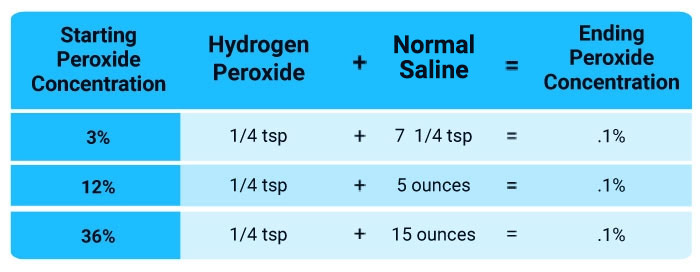
I recommend diluting the peroxide down to 0.1%. Brownstein recommends using an ultralow dilution of 0.04% while Levy recommends 3% or less, depending on individual patient tolerance and how sick the patient already is.

If you don’t have access to saline, you could make your own by mixing one teaspoon of unprocessed salt (such as Himalayan salt, Celtic salt or Redmond's real salt) into a pint of distilled water. This will give you a 0.9% saline solution, which is about the concentration found in body fluids. Using that saline, you will then dilute the hydrogen peroxide as described in this chart.

hydrogen peroxide dilution chart

With regard to the dilution, Levy offers the following commentary:

“I don't think there's any evidence really that 0.04% nebulization as a monotherapy is going to get the job done. I want something that anybody on the planet can use to resolve [their infection] without having to add vitamin C, without having to add iodine, without having availability of ozone.

And when you start taking the concentration down, you're going to get less antipathogenic impact by definition. That, combined with the fact that for a year now, I've been getting an incredible amount of positive feedback. I've had no negative feedback. Most people use 3%. Some get too much tingling in the nose and they'll go down to 1.5% or even 1%.

I think it's a whole different thing as to what concentration you might want to use for the maintenance therapy that we're talking about. But I think there's no good reason at all not to take your first shot at 3% when you're already having symptoms, or if you have a COVID-positive test.

I see no reason to dance lightly, especially in the fact that we have no negative feedback. Also, a recent article showed that people who routinely gargle with 3% peroxide show zero microscopic abnormalities in the tissue after a six-month period …

I never advise somebody to tolerate symptoms that they find uncomfortable. I always say, find a concentration of whatever you're nebulizing that's comfortable. But that said, I still think when you clearly have an infection, hit it hard the first few times, I don't think you're going to do any damage.”

Other Health Benefits of Nebulized Peroxide

Aside from fighting infections, nebulized peroxide also has other health benefits, including treating chronic obstructive pulmonary disease, which is a common side effect of smoking, and emphysema. As noted by Levy, while it doesn’t necessarily repair the anatomy of your air sacs, it does address the chronic infections and mucus production caused by these conditions.

“I've had a lot of feedback from chronic lung patients that are pretty much ecstatic that they were able to incorporate this into their long-term medical treatment protocols,” Levy says.

Another interesting benefit of this therapy is its ability to improve your gut microbiome. Levy appears to have been the first one to discover and discuss this benefit:

“The first time I nebulized with, at that time, regular over-the-counter 3% peroxide, the next morning I had the most incredibly normal, well-formed bowel movement of my life. I said, ‘Good grief. What is going on here?’ The only thing I did different was the peroxide nebulization the day before, and that got me to thinking about how all disease is oxidation versus reduction.”

As noted by Levy, chronic infection is a primary source of toxins in the body for most people, be it from infected tonsils, teeth, gums or anything else, and this also affects your microbiome.

Nebulized hydrogen peroxide, by addressing these chronic infections, may therefore also help reestablish a healthier bacterial balance in your gut. Levy recounts how patients with chronic irritable bowel syndrome were able to reverse their condition in as little as one week of nebulization.

“I don't want to oversimplify what's going on in the gut,” he says. “I know it's a very complex process, but bottom line is that what keeps any tissue in a state of ‘disease’ is increased pro-oxidant factors coming in and the degree to which you can stop those pro-oxidant factors.

With my bowel habits changing in less than 12 hours, that really tells me, intuitively, how readily a leaky gut can heal if you stop the 24/7 onslaught of new toxins and pathogens getting dumped into the gut …

I don't think nebulization is directly putting a clinically significant amount of peroxide in and around the gut. Its primary role is killing the pathogens that chronically grow there in the nose and throat, preventing a continual swallowing of pro-oxidant pathogens and their associated toxins.

There's a concept in my book called chronic pathogen colonization, where those bugs are covered with biofilms, and … peroxide destroys the biofilm quickly and then kills the pathogens underneath …

I think peroxide nebulization should be a routine part of any treatment protocol for any medical condition because of the positive impact it has on the microbiome and leaky gut, which makes any chronic disease you have worse.”

Hydrogen Peroxide for Periodontitis

A third benefit is its ability to address gum disease (periodontitis) and all the various health conditions associated with or worsened by it. As just one example, if you have severe asthma and advanced periodontitis, when your periodontitis flares, so will your asthma. Once you start to resolve the periodontitis, your asthma will typically improve as well.

“What’s unique about periodontitis is the nature of the pathogens,” Levy explains. “Often it’s caused by a bug called Porphyromonas gingivalis. They're now finding this pathogen by advanced PCR testing to be present in many different tissues in the body, and to be present in tissues that are diseased.

They've identified it in Alzheimer's tissue, in different neurological tissues. It's been identified in the coronary artery linings of patients that have coronary artery disease …

That's all coronary artery disease is — a chronic immune response that's never extinguished because the seeding of bugs from the mouth is never extinguished … The reason smokers have such a high incidence of heart disease is because all of them have induced periodontitis that has the type of pathogen that metastasizes to the coronary artery lining.”

On a personal note, last year during a health checkup at SanoViv in Mexico, I learned I had periodontitis, which surprised me considering I don’t smoke and have a very healthy lifestyle. It goes to show how easily it can happen and, according to Levy, one of the reasons for this is depleted vitamin C stores. I was able to completely reverse it using ozone therapy, but as noted by Levy, the depleted vitamin C also needs to be addressed. He says:

“One main deficiency of things like ozone and other bio-oxidative therapies is they're highly effective at killing the pathogen, but they've got nothing to do with restoring the antioxidant vitamin C status that resulted from the pathogen being present. All these viruses that we get acutely rapidly destroy our vitamin C stores.

Things like Ebola, where people die of hemorrhage, that’s really acute scurvy. In fact, it's my opinion that long-haul COVID-19 is simply because of the fact that you so effectively nuked a large amount of your nutrients, especially vitamin C, that unless you undergo an accelerated plan of restitution, not a maintenance plan, but an accelerated plan of restitution, you’re never going to get back to baseline.

Same thing with periodontitis. Any dentist will tell you, they've never seen a smoker with normal gums. It just doesn’t occur. But the point is that smoke is metabolizing the vitamin C rapidly in the gums themselves.”

While you would get some benefit by nebulizing hydrogen peroxide through your mouth (i.e., breathing through your mouth rather than your nose), Levy recommends using a water irrigation (Waterpik™) device for this. Use warm water or warmed saline and add one-half to 1 or even 2 tablespoons of 3% food-grade hydrogen peroxide to the water tank.

“Those pathogens get knocked out quick. When you have advanced periodontitis, you no longer have the little peaks of gum tissue between the teeth. They've just resorbed completely.

But even in that type of gum, I've seen new gum grow in quite nicely in a couple of weeks. So basically, when you take the ongoing infective presence out of there, they will regenerate rapidly, especially if you're not smoking while maintaining a good vitamin C intake.”

More Information

If you don’t have any chronic medical condition, Levy suggests nebulizing hydrogen peroxide two to three times a week for one to three minutes. If you have a chronic health condition, you’ll want to do it more frequently. For acute symptoms, you’ll typically want to nebulize for 10 to 15 minutes at a time.

For more details, be sure to download Levy’s book, “Rapid Virus Recovery.” It’s a free download. Also be sure to share it with your friends, family and social networks. Nebulized hydrogen peroxide is a simple, inexpensive way to improve your health and safeguard against viral infections of all kinds, and anyone can use it.

“Send the link to as many people as possible,” Levy says. “That's the whole reason for this book. I can't imagine anybody being offended by the offer of a free book.”


from Articles https://ift.tt/3wn2VqW
via IFTTT

Comedian and television presenter Julia Morris has had it – with the fallacy of perfect marriages, with the idea that women (of any age) shouldn’t feel emboldened to speak out, and most particularly with the cadre of rich celebrities who peddle wellness like it’s their second calling.

from Health | body+soul https://ift.tt/3fEVzcr

Researchers have identified nine potential new COVID-19 treatments, including three that are already approved by the U.S. Food and Drug Administration for treating other diseases. The team screened thousands of existing drugs and drug-like molecules for their ability to inhibit the replication of the COVID-19-causing coronavirus, SARS-CoV-2.

from Top Health News -- ScienceDaily https://ift.tt/3wpxAnF

MKRdezign

Contact Form

Name

Email *

Message *

Powered by Blogger.
Javascript DisablePlease Enable Javascript To See All Widget