Health, Fitness,Dite plan, health tips,athletic club,crunch fitness,fitness studio,lose weight,fitness world,mens health,aerobic,personal trainer,lifetime fitness,nutrition,workout,fitness first,weight loss,how to lose weight,exercise,24 hour fitness,
Labels
Technology
New Post
[recent][newsticker]
Latest Post
Top Health News -- ScienceDaily
Aging
Alzheimer's
Articles
Articles : Asthma
Articles : CAFO
Articles : Children's Health
Articles : Cholesterol
Articles : Emotional Health
Articles : Fibromyalgia
Articles : GMO
Articles : Heart Health
Articles : Hormones
Articles : Internal Videos
Articles : Interviews
Articles : Men's Health
Articles : Politics
Articles : Thyroid Disease
Articles : Vaccines
Autism
best natural health source
Children's Health
Detoxification
Diabetes
Diet | body+soul
Diet and Weight Loss News -- ScienceDaily
Digestive Diseases
Dite
Dite & weight loss
Drug Industry
Drugs
EFT
EMF
Emotional Health
Finances
fitness
Fitness | body+soul
Fitness/Exercise
Fluoride
Food
Fructose/Sugar
Gardening
Harvard Health Blog
Health
Health | body+soul
Health and Wellness
health news
health tips
Heart Health
information
Joint Support
Juicing
Men's Health
news
Nutrition
Nutrition | body+soul
Pollution
Raw Milk
Soy
Supplements
Swine Flu
Technology
Thyroid Disease
Top Health
Top Health News -- ScienceDaily
Under Armour
Vaccines
Weight Management
women's health
Women's Health News -- ScienceDaily
work place health
Workplace Health News -- ScienceDaily
Machine learning that works like a dream
Researchers have developed a machine learning algorithm that classifies the sleep stages of mice with record accuracy. This work may be used to greatly enhance the field of sleep research.
from Top Health News -- ScienceDaily https://ift.tt/2RjobvD
from Top Health News -- ScienceDaily https://ift.tt/2RjobvD
Link between obesity and gum disease
Obesity and gum (periodontal) disease are among the most common non-communicable diseases in the United States -- and studies show these chronic conditions may be related. This new study explores the effect of obesity on non-surgical periodontal care and evaluates potential pathways that may illustrate the connection between the two conditions.
from Diet and Weight Loss News -- ScienceDaily https://ift.tt/2DJBopJ
from Diet and Weight Loss News -- ScienceDaily https://ift.tt/2DJBopJ
The complicated relationship between fish oil and heart health
For nearly two decades, the American Heart Association (AHA) has recommended that people with coronary heart disease (CHD) consume omega-3-fatty acids (the kinds of fatty acids found in fish and fish oil) to prevent another heart attack. This recommendation was based on early randomized, controlled trials, which found that fish oil supplementation was associated with lower rates of stroke, heart attack, and death in people who already had heart disease. On the other hand, the impact of fish oil supplements on preventing a first heart attack or stroke (primary prevention) was never clearly demonstrated.
Recently there have been large trials examining the complex relationship between fish oil and heart health. The results have been mixed and somewhat confusing, leaving both patients and physicians to wonder: will fish oil supplements reduce my risk of heart disease?
What’s the connection between fish oil and heart health?
How might omega-3-fatty acids found in fish oil provide heart health? Multiple possibilities have been proposed and are supported by animal research. These protective mechanisms include
- stabilizing blood flow in and around the heart
- reducing blood triglyceride levels
- lowering blood pressure
- preventing blood clots
- reducing inflammation.
Research examining each of these is ongoing.
Many studies, varied results
Despite these animal data, clinical studies in humans have not consistently supported the protective benefits of fish oil supplementation.
A meta‐analysis published in JAMA Cardiology found no clear benefit to fish oil supplements in preventing heart disease or major cardiovascular disease (CVD) events such as heart attack or stroke, in people who were at increased risk for CVD.
This was followed by the publication of the ASCEND and VITAL trials, both with mixed results. In ASCEND, which examined diabetic patients without known CHD, fish oil supplements did not reduce heart attacks or strokes, but did significantly lower risk of death from heart attack and stroke. VITAL examined the effects of fish oil on primary prevention in people with regular risk of heart disease, and also failed to find a significant reduction in all major CVD events. However, there were fewer heart attacks in study subjects who took fish oil supplements, particularly in those who did not eat fish.
The REDUCE‐IT trial was published next. This trial looked at the effect of high-dose fish oil supplements on people with high blood triglyceride levels who were at elevated CVD risk. In contrast to previous studies, REDUCE-IT found a significant reduction in cardiovascular events among study subjects who took the high-dose fish oil supplements. While most studies have tested 1 gram or less of fish oil with a combination of eicosapentaenoic acid (EPA) and docosahexaenoic (DHA), REDUCE-IT used a dose of 4 grams of EPA alone. (Vascepa, a prescription version of the EPA fish oil supplement used in REDUCE-IT, is FDA-approved to treat very high triglyceride levels of 500 mg/dl or higher. In November, the FDA expanded its approval of Vascepa; it can now be prescribed to reduce the risk of cardiovascular events like heart attack and stroke.)
In October 2019, a repeat of the JAMA Cardiology meta-analysis, but now including 13 trials instead of the original 10, was published in the Journal of the American Heart Association. The addition of these three trials increased the sample size by almost 65%, from 77,917 study participants to 127,477 participants. In reanalyzing the expanded data, researchers found that fish oil omega‐3 supplements lowered risk for heart attack and CHD death. There was no effect on stroke. Interestingly, risk reductions appeared to be linearly related to omega‐3 dose. In other words, the higher the dose, the greater the risk reduction.
What does this mean for you?
Omega-3 supplements from fish oil appear to be heart-healthy and have a protective effect on CHD. But before we all start reaching for supplements, it may be worth following a heart-healthy diet full of fresh fruits and vegetables, with lean protein such as fish, as recommended by the AHA. For those of us at highest risk, especially those with elevated triglyceride levels, it is worth speaking with your physician about high dose EPA fish oil supplements.
The post The complicated relationship between fish oil and heart health appeared first on Harvard Health Blog.
from Harvard Health Blog https://ift.tt/2Rj9CYY
A common drug could help restore limb function after spinal cord injury
Long-term treatment with gabapentin, a commonly prescribed drug for nerve pain, could help restore upper limb function after a spinal cord injury, new research in mice suggests.
from Top Health News -- ScienceDaily https://ift.tt/2Lnrazi
from Top Health News -- ScienceDaily https://ift.tt/2Lnrazi
This Protein Could Signal Early Death
Statistics from the American Heart Disease 2019 update shows cardiovascular disease (CVD) is still the leading cause of death, although the rate decreased by 18.6% from 2006 to 2016.1 Despite this reduction, 1.05 million people were expected to have a coronary event in 2019, including 720,000 first time and 335,000 recurrent events.
Nearly every 40 seconds someone has a heart attack or a stroke. In 2014-2015 the annual financial burden for CVD was estimated at $351.2 billion. In the survey, the data showed awareness of the symptoms of a heart attack was low.2
This has a negative impact on early diagnosis and treatment of a heart attack, which is linked to a higher potential for survival and return to normal activities when more of the heart muscle can be saved.
According to the Centers for Disease Control and Prevention,3 nearly 47% of sudden cardiac death happens outside of a hospital, which suggests people may be unaware they have heart disease, or they don't act on early warning signs of a heart attack.
Those at greater risk of a cardiac event include people who have other medical conditions such as diabetes or practice specific lifestyle choices, such as eating a poor diet, excessive alcohol use, smoking or lack of physical activity.
Protein Linked to Muscle Damage Raises Risk of Death
Once your heart has begun to be damaged by a heart attack, the heart muscle releases a protein, troponin, which is responsible for helping to regulate contractions in skeletal and heart muscle.4 Emergency room physicians test for blood levels of this protein, along with other clinical tests, to evaluate the likelihood a patient is having a heart attack.
The level of the protein and other test results help clinicians make choices about immediate treatment. A new analysis from the National Institute for Health Research Health Informatics Collaborative led by researchers from London looked at data from 250,000 patients who had troponin tests completed.
The information was grouped by age and then compared against the test results and the patient's health outcomes in the following three years. The researchers were interested in comparing the differences in troponin levels across age ranges, specifically in the senior population, as well as investigating the significance of the different levels of the protein.
The new data showed even a slight raise in the level of protein was associated with an increased risk of early death in all age groups. They also found the higher the level, the higher the risk of death in those who had suffered a heart attack.
However, patients who had the highest levels had a lower risk of dying, which the researchers theorized was due to the likelihood the patient had an event requiring surgery that may have reduced the risk of death. The data also showed patients from 18 to 29 years with raised levels had a tenfold higher potential risk of dying than those in the same age range without raised levels of troponin.
When the patients were over 80 years with raised levels, 46% died within three years.5 The lead scientist of the study commented in a press release:6
"There have been many advances in treating heart disease yet it remains the leading cause of death in the UK and around the world. This is the first study to address the implications of raised troponin in a real world large sample of patients across a wide range of ages.
Doctors will be able to use this information to help identify the risk of early death in patients who have a troponin level measured; this could lead to interventions at a much earlier stage in a wider group of patients than are currently treated."
Other Things Can Also Raise Troponin Levels
The results also revealed, even if the patient had not been diagnosed with a heart attack, those who had higher levels of troponin had an increased risk of death.7 When you are healthy, levels of troponin are low enough they are usually undetectable. The levels begin rising three to four hours after heart damage and may stay elevated for 14 days.
However, troponin protein may be released into your bloodstream following more than a heart attack.8 Physicians from the Cleveland Clinic discuss several other health conditions during which your body releases troponin, which may signal an increased risk of death without early treatment.
• Sepsis — This is a life-threatening condition triggered by a systemic infection that ultimately affects the function of your vital organs. Sepsis is sometimes referred to as blood poisoning and it is conservatively estimated to be responsible for 270,000 deaths each year.
Troponin elevations may be the result of a combination of renal dysfunction, massive inflammatory response and increasing levels of catecholamine damage to the heart.
• Stroke — An acute ischemic stroke may raise troponin levels by triggering a variety of cardiovascular responses increasing stress on the heart. Troponin levels may also rise through neurogenic heart damage and alterations to the autonomic nervous system control.
This results in a catecholamine surge and damage to the myocardium. Scientists theorize this may explain the presence of rising levels in an ischemic stroke in the absence of coronary artery disease.
• Pulmonary disease — A strain on the right side of the heart from pulmonary disease may mark right ventricular dysfunction or indicate severe disease and poor outcomes in those who have high pulmonary arterial pressure.
An acute exacerbation of chronic obstructive pulmonary disease has been linked to an increase in all-cause mortality with elevations of serum troponin.
• Chronic kidney disease — Troponin is cleared by the kidney, which may be one explanation for elevated levels in those with chronic kidney disease. Elevations may also be the result of elevation in proinflammatory cytokines and associated high blood pressure.
• Chemotherapy — Chemotherapy can induce cardiac toxicity through the production of oxygen free radicals and by disturbing mitochondrial metabolism. When left ventricular deterioration is associated with chemotherapy it is often irreversible. By monitoring troponin levels problems may be identified before cardiac symptoms are clinically evident.
Can You Have a Heart Attack and Not Know It?
Although the terms are used interchangeably, a heart attack and cardiac arrest are not the same thing. A heart attack affects the oxygen supply to your heart while a cardiac arrest affects the electrical impulse. During a heart attack, restriction of oxygen occurs with a blockage to the blood supply, but the remainder of the muscle continues to beat.
During a cardiac arrest, the electrical system is affected by conditions such as heart failure, arrhythmias or ventricular fibrillation, usually resulting in a loss of consciousness and heartbeat. In some instances, just before cardiac arrest, you may notice abnormal gasping or there may be seizure activity at the beginning of the event.
Symptoms of a heart attack are not always obvious. However, immediate treatment often results in higher survival rates and loss of less heart muscle from lack of oxygen. Common symptoms of a heart attack include:
|
Chest pain or discomfort |
Upper body discomfort |
Shortness of breath |
|
Breaking out in a cold sweat |
Sudden dizziness |
|
|
Feeling unusually tired |
Lightheadedness |
Not all heart attacks begin with crushing chest pain as is depicted on television or in the movies. Women are less likely to report chest pain during a heart attack and more likely to perceive the symptoms as stress or anxiety. Women use terms such as "pressure," "tightness" or "discomfort" rather than chest pain.
While 30% of women will seek medical care compared to 22% of men, physicians tend to misdiagnose or dismiss the symptoms of a heart attack in women rather than men. Other symptoms that may indicate a heart attack is in progress include:
|
Anxiety attack |
|
|
Heartburn |
Hot flashes |
|
Extreme fatigue |
Feeling electric shocks down on the left side |
|
Numbness and stiffness in the left arm and neck |
Feeling like there is a large pill stuck in your throat |
Know Your Risk Factors and Take Action
Research published in the American Journal of Cardiology found women who addressed six lifestyle factors had the greatest impact on their heart health. In the study, nurses were followed for 20 years, starting around age 37.
Those who adhered to all six guidelines lowered their risk of heart disease by 92%. Researchers on the team estimated more than 70% of heart attacks could be prevented by implementing:
|
Healthy diet |
Achieving a normal BMI (body fat percentage is more accurate) |
|
Getting at least 2.5 hours of exercise each week |
Watching television seven or fewer hours per week |
|
Not smoking |
Limiting alcohol intake to one drink or less per day |
While none of these factors should come as a surprise, they collectively have an impressive impact on your cardiac risk. With respect to BMI, note that your waist-to-hip ratio is a more reliable predictor of risk than BMI, as it reflects the amount of visceral fat you carry. Another factor that can increase inflammation, activate your sympathetic nervous system and trigger a heart attack is stress.
Additionally, sitting for long periods of time raises your risk of a heart attack. This means intermittent movement and spending time at the gym or exercising at home are important factors to lowering your risk of CVD.
Some of the uncommon symptoms may lead you to believe you are not having a heart attack. Even if you're not sure, it is vital that you call for immediate emergency assistance as time is a significant factor in improving your potential for survival.
An ambulance is the best and safest way to reach the hospital because emergency personnel can use treatments enroute before reaching the emergency room. Emergency medical personnel would rather treat you for a non-life-threatening condition then have you die because you are unwilling to go for treatment.
Talk with your health care provider about your risks and keep important information with you in case of an emergency. For instance, write down all your medications and supplements you're taking and have the card laminated, keeping it in your wallet or purse.

from Articles https://ift.tt/2P9h2vf
via IFTTT
WebMD and Healthline Exposed Violating Your Privacy
Expert Review by Maryam Henein
As reported in a November 12, 2019, Financial Times article,1 dozens of popular health websites are tracking, storing and sharing your personal data, including WebMD (the leading health website) and Healthline (currently the third most popular health site2).
These two websites also, as of this year, dominate Google health searches, which virtually guarantees their continued growth and influence. “Establishment, big corporate pharma websites like WebMD are monopolizing the first page of results,” Google Whistleblower Zach Vorhies confirmed in an interview with The Epoch Times.3
I wrote about how these two websites use and share your data in my November 8, 2019, article “Shocking Proof How Google Censors Health News.” I’ve also covered this issue in other articles, so the Financial Times’ report came as no surprise to me.
What some might not know is that this kind of information sharing is illegal in Europe. As reported by Financial Times:4
“Using open-source tools to analyse 100 health websites, which include WebMD, Healthline, Babycentre and Bupa, an FT investigation found that 79 per cent of the sites dropped ‘cookies’ — little bits of code that, when embedded in your browser, allow third-party companies to track individuals around the internet. This was done without the consent that is a legal requirement in the UK.”
Seventy-eight percent of the sites shared user data with DoubleClick, Google’s advertising arm, while 48% shared data with Amazon. Facebook, Microsoft and AppNexus, another advertising firm, also received user data.
What this means is DoubleClick, Google’s ad service, will know which prescriptions you’ve searched for on these websites, thus providing you with personalized drug ads, and Facebook will know what you’ve searched for in WebMD’s symptom checker, as well as any diagnoses you received.
European Law Is Unambiguous and Far Stricter Than the US
According to Financial Times,5 “keywords such as ‘heart disease’ and ‘considering abortion’ were shared” from several sites, including Healthline, and eight of the 100 sites tested included specific identifiers that allow third parties to tie the information to specific individuals. Tracker cookies were also dropped without consent or before any consent was given.
The following graphic, created by Financial Times, illustrates the flow of data from BabyCenter.com, a site that focuses on pregnancy, children’s health and parenting, to third parties, and the types of advertising these third parties then generate.
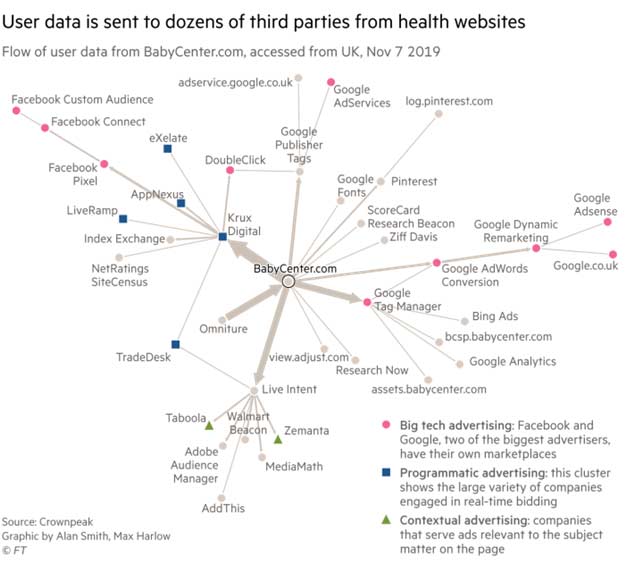
Wolfie Christl, a technologist and researcher, told Financial Times:6 “These findings are quite remarkable, and very concerning. From my perspective, this kind of data are clearly sensitive, has special protections under the [General Data Protection Regulation] and transmitting this data most likely violates the law.”
Phil Smith, director-general of the U.K.s Incorporated Society of British Advertisers told Campaignlive.com7 that the EU’s General Data Protection Regulation — which was implemented in May 2018 — is unambiguous and straight-forward: Websites must request and obtain “explicit consent for the sharing of ‘special category data,’” which includes health data.
Other special category data considered to be particularly sensitive and needing explicit consent to be shared include race, ethnic origin, political persuasion, religious affiliation, trade union membership, genetics, biometrics, sexual orientation and details relating to your sex life.
Weeding Out ‘Undesirables’
In response to Financial Times’ report, Google said it “does not build advertising profiles from sensitive data,” and that it has “strict policies preventing advertisers from using such data to target ads."8 Well, if it’s not being used to personalize medical ads, what is the health data being used for, and why is it collected and shared in the first place?
According to Tim Libert, a computer scientist at Carnegie Mellon University who developed the open-source tool Financial Times used to investigate the information sharing, medical information can be used to “prey on the ill and vulnerable.”9 Health data can also be used to secretly discriminate against certain individuals. As noted by Libert:10
“As medical expenses leave many with less to spend on luxuries, these users may be segregated into ‘data silos’ of undesirables who are then excluded from favorable offers and prices. This forms a subtle, but real, form of discrimination against those perceived to be ill.”
Your Mental Health Data Is Also Shared
A September 3, 2019, report11 by the data privacy advocacy group Privacy International revealed mental health websites are also sharing sensitive personal data with third parties — including the answers and results from depression tests — again without the consent required under EU law.
This analysis looked at 136 European mental health web pages, finding 97.8% of them had third-party elements such as cookies, and 76.04% had third-party trackers for marketing purposes.12
What’s more, some websites shared data with third parties in hypertext transfer protocol (HTTP) rather than hypertext transfer protocol secure (HTTPS), used for secure communications over a computer network, which means the data, which contains unique identifiers, is susceptible to interception by hackers as well.13
Two sites, the NHS mood test and depression.org.nz, also used “session replay scripts,” which “can be used to log (and then play back) everything users typed or clicked on a website.”14 In other words, they would be able to tell whether you altered your test answers and/or searches.
Opt Out Option Is Still Not User Friendly
On a side note, Financial Times brings up a popup about its cookies and gives you the option to opt out of advertising based on your use of the Financial Times site. It also gives you the option to opt out of advertising based on your online activity, which is tracked by third party cookies linked to its site.
Looking at their Manage Cookies page,15 you can get a feel for just how extensive that online activity tracking is. There are dozens of third party trackers, and you’d have to go to each one to opt out! Who has time for all of that — especially since you have to do that for every browser you use, and for every site you visit? While having the option to opt out is a step in the right direction, it’s still an unmanageable system for most users.
As noted in the Privacy International report, “The burden should be on websites to protect user privacy by design and by default.”16 In the meantime, Privacy International offers the following recommendations “to anybody looking for help and support online”:17
- Block third party cookies on your browsers
- Use ad blockers and antitracking add-ons
- Before completing an online test for a mental health condition, make sure the website is trustworthy. If in doubt, seek out information from public health bodies, medical professionals or qualified charities
- In the U.K., Samaritans can be contacted on 116 123. In Australia, the crisis support service Lifeline is on 13 11 14. In the U.S., the suicide prevention lifeline is 1-800-273-8255. Other international helplines can be found at www.befrienders.org
Health Publishers Make Millions Off Online Searches
A recent AdBeat blog18 reviews just how all of this personal information is being used to generate millions in advertising revenue. Health websites obviously attract drug ads and sponsorships, and the pharmaceutical industry has deep pockets. In his blog, Bradley Nickel points out that:
“According to the Pew Research Center, 72% of people looked online for health information within the past year … WebMD reports an average of 206 million unique users per month, and over 400 billion page views per quarter.”
There are many ways in which all these page views can be turned into revenue. Nickel reviews the monetization strategies of five health publishers: LifeScript (a women’s health publisher), WebMD, HealthCentral, eMedTV and Healthline.
Estimates suggest WebMD made $10,977,280 in advertising revenue in six months, which means its total revenue for a single year could reach as high as $22 million. A majority of this revenue comes from direct buys.
A majority of ads on WebMD are for over-the-counter drugs, which are strategically placed on related pages, meaning if you’re searching for “common cold,” you’re likely to find ads for Nyquil, Tylenol Cold & Flu, Sudafed and similar cold and flu remedies.
Healthline Is All About Matching Users to Its Advertisers
Healthline is not too far behind WebMD with an estimated six-month ad revenue of $7,025,644, with a majority of it coming from direct buys. Unlike WebMD, Healthline’s top ads are prescription drugs. As noted by Nickel:19
“Direct Buys are the name of the game when it comes to monetizing traffic from sites related to health and wellness. A prescription drug company is a publisher’s dream.
Drug companies tend to have lots of cash to spend on advertising, a desire for large amounts of traffic, and getting permission to advertise prescription drugs on Google and other ad networks can be difficult.”
In all, Healthline Media made more than $100 million in 2018. A big part of its rapidly growing success is its focus on content, AdExchanger contends.20 Before 2011, Healthline licensed content and didn’t create any of its own — a decision that threatened to bankrupt the company. According to AdExchanger:21
“Today, Healthline employs 150 clinicians to review articles and cites academic research in stories. When Google revamped its search algorithm in fall 2018, with the ‘Medic’ update,22 which changed the rankings for health sites based on the quality of their content, Healthline saw even more organic traffic sent its way.”
In an interview with AdExchanger, Healthline Media CEO David Kopp explains how user data are used to satisfy the needs of its direct advertisers. “Several hundred data points” are monitored internally, Kopp says, and for 32% of the company’s advertisers, the first or second metric is audience quality or cost per qualified user.
“For pharma, it might be someone diagnosed with a disease, and for a hospital, it might be someone looking for an ER in a geographic area,” he says. To allow advertisers to reach their target audience, Healthline places their advertisements “on content that is relevant to the product.”
This, clearly, is the most effective way to sell a product. Talk about its benefits in an article, and have ads for that very product in the side bar. This, by the way, is illegal for nutritional supplements. I cannot tell you about how to use berberine to treat your Type 2 diabetes and link to a berberine product in my online store, for example. Yet, this is precisely what they’re doing with drugs.
Healthline also offers condition-specific apps, where users can connect with others who have the same medical condition as they. This, undoubtedly, gives advertisers a first-row seat with a captive audience — a very select group of people they can be sure are looking for specific remedies and products.
Boycott Google to Protect Your Privacy
In addition to all of this data mining, Google is also actively manipulating search results and making decisions about what you’re allowed to see and what you’re not based on its own and third party interests — a topic detailed in a November 15, 2019, Wall Street Journal investigation.23
The dangers of censorship, data mining of sensitive information and tracking should be self-evident. It won’t take long before most people think and believe whatever Google and its advertisers want people to think and believe, and spend their money accordingly.
This data mining could also end up being used in some sort of “social credit” system, similar to what already exists in China. Imagine not being allowed to purchase airplane tickets because you’re suspected of having a cold, based on your online searches and purchases, for example.
Or, think what would happen if you are being denied a gym membership because you’ve been logged as having an STD. In truth, personal data can be misused in any number of unimaginable and discriminatory ways.
Now, more than ever, we must work together to share health information with others by word of mouth, by text and email. We have built in simple sharing tools at the top of each article so you can easily email or text interesting articles to your friends and family.
My information is here because all of you support and share it, and we can do this without Big Tech’s support. It’s time to boycott and share! Here are a few other suggestions:
|
Become a subscriber to my newsletter and encourage your friends and family to do the same. This is the easiest and safest way to make sure you’ll stay up to date on important health and environmental issues. |
|
If you have any friends or relatives who are seriously interested in their health, please share important articles with them and encourage them to subscribe to our newsletter. |
|
Consider dumping any Android phone the next time you get a phone. Android is a Google operating system and will seek to gather as much data as they can about you for their benefit. iPhone, while not perfect, appears to have better privacy protections. |
|
Use the internal Mercola.com search engine when searching for articles on my site. |
|
Boycott Google by avoiding any and all Google products:
|
|
Sign the “Don’t be evil” petition created by Citizens Against Monopoly |

from Articles https://ift.tt/2Ygajnp
via IFTTT
MKRdezign
Powered by Blogger.